A Heart Valve Designed to Grow: New Hope for Children Born with Heart Defects
Posted 1 day ago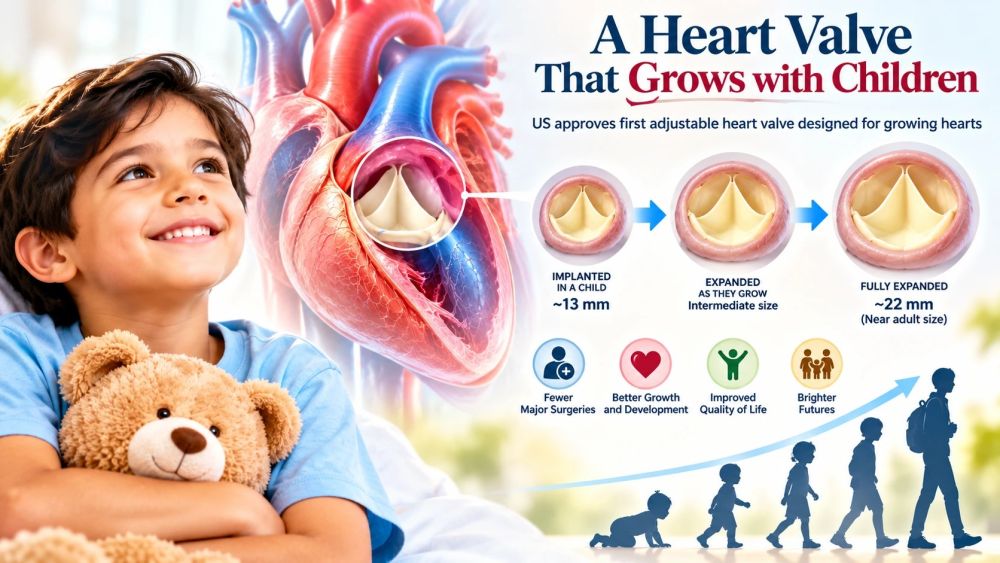
63/2026
The US Food and Drug Administration (FDA) approved the Autus Size-Adjustable Valve on 1 October 2026, making it the first heart valve approved for post-implantation expansion to accommodate a growing child. The device is intended for children who need a pulmonary valve replacement, which controls blood flow from the heart to the lungs.
The innovation addresses a long-standing challenge in pediatric cardiac surgery: a replacement valve that works well in a young child may become too small as the child grows, potentially requiring another major operation.
Why growing children need a different kind of heart valve
The human heart has four valves that keep blood flowing in the right direction. The pulmonary valve allows blood to leave the right side of the heart and travel to the lungs, where it picks up oxygen before returning to the heart.
Some children are born with congenital heart defects that affect the structure or function of this valve. It may be too narrow, fail to open properly, or allow blood to flow backward. In some cases, surgeons must replace it to restore effective circulation.
Traditional replacement valves pose a particular challenge for children. Unlike an adult’s body, a child’s body continues to grow, but an implanted artificial valve does not automatically increase in size. Biological valves made from animal tissue can also deteriorate over time, increasing the likelihood of further procedures.
As a result, some young patients undergo a series of operations as they grow from infancy into adulthood.
The Autus valve introduces a different approach: instead of treating the replacement valve as a fixed-size device, doctors can enlarge it as the child's needs change.
How does the new technology work?
The valve can initially be implanted at a diameter of approximately 13 millimeters, suitable for selected young children. As the patient grows, doctors can use a balloon catheter, a thin tube with a small inflatable balloon, to widen the implanted valve via a catheter-based procedure. Its diameter can eventually reach approximately 22 millimeters, approaching the size of an adult pulmonary valve.
This adjustment helps the valve accommodate a larger blood-flow pathway without requiring surgeons to remove the original device and replace it in another open-heart operation.
The valve also marks a significant materials-science advance. Its delicate inner flaps, known as leaflets, are made from a synthetic polymer rather than the animal-derived tissue used in many conventional biological valves. These leaflets open to let blood pass and close to prevent it from flowing backward. The FDA says the new valve is the first approved heart valve in the United States to use polymeric material for its leaflets. Early follow-up data suggest promising performance, although its long-term durability remains under investigation.
What does the scientific evidence show?
The FDA's decision was based on empirical evidence from a clinical study of 62 children treated at 12 sites across the United States. The results offer encouraging early evidence that the technology can function effectively in children who require pulmonary valve replacement.
At the one-year follow-up, the first 60 patients assessed had acceptable blood-flow measurements and no more than mild valve leakage. All procedures were successful, and the study reported no deaths, strokes, or blood clots requiring additional treatment.
However, the results also identified issues that require continued monitoring. One patient showed trivial pulmonary regurgitation. In addition, researchers successfully expanded the devices in two children whose valves were beginning to become too small, without another open-heart operation.
These findings are promising, but the patient numbers remain relatively small, and follow-up remains limited. Longer-term studies are needed to determine how reliably the valve performs over many years and whether its adjustable design will substantially reduce the total number of operations children undergo.
A shift towards lifelong, personalized heart care
The significance of this development extends beyond the valve itself. It reflects a broader shift in medical engineering: designing treatments around the evolving needs of the patient rather than expecting the patient to adapt to a fixed medical device.
For a child with congenital heart disease, avoiding even one major operation could mean less physical stress, a shorter recovery, and fewer disruptions to schooling and family life. The potential benefits could extend into adolescence and adulthood, when the cumulative burden of repeated procedures becomes especially significant.
Yet the new valve should not be viewed as a permanent solution for every child. Its suitability depends on the patient's heart anatomy, the severity of the valve defect, and specialist clinical assessment. Nor does the ability to expand the valve guarantee that it will last a lifetime or eliminate the need for future surgery.
The FDA approved the device through its premarket approval pathway, its most stringent route for certain high-risk medical devices. The device's development also marks the first pediatric approval under the FDA's Total Product Life Cycle Advisory Program, which supports the development of innovative medical technologies.
What could this mean for the future?
The Autus valve offers a compelling example of how advances in biomaterials, catheter-based procedures, and pediatric cardiac surgery can come together to address a problem that has challenged doctors for decades.
The next test will be whether long-term clinical evidence confirms that promise. Researchers will need to establish the valve's durability, the safety of repeated expansion, and its performance as children mature.
Disclaimer
The contents provided on www.biomedglobal.org are intended for general informational and educational purposes only. This website's information, articles, and resources are based on data and findings from scientific publications, publicly available research, and reputable sources.
While every effort is made to ensure accuracy and reliability, Biomed Global does not guarantee, endorse, or assume responsibility for the completeness, timeliness, or validity of the information.
The material on this website should not be considered a substitute for professional advice, diagnosis, or treatment. Users are strongly encouraged to consult qualified healthcare professionals, researchers, or subject-matter experts before making decisions based on the information presented here.
Under no circumstances shall Biomed Global, its affiliates, contributors, or authors be held liable for any direct, indirect, incidental, or consequential damages arising from the use of, or reliance on, the content of this website.
By accessing and using www.biomedglobal.org, you fully acknowledge and agree to this disclaimer.