Airborne Environmental DNA: A New Frontier in Molecular Ecology and Environmental Surveillance
Posted 6 months ago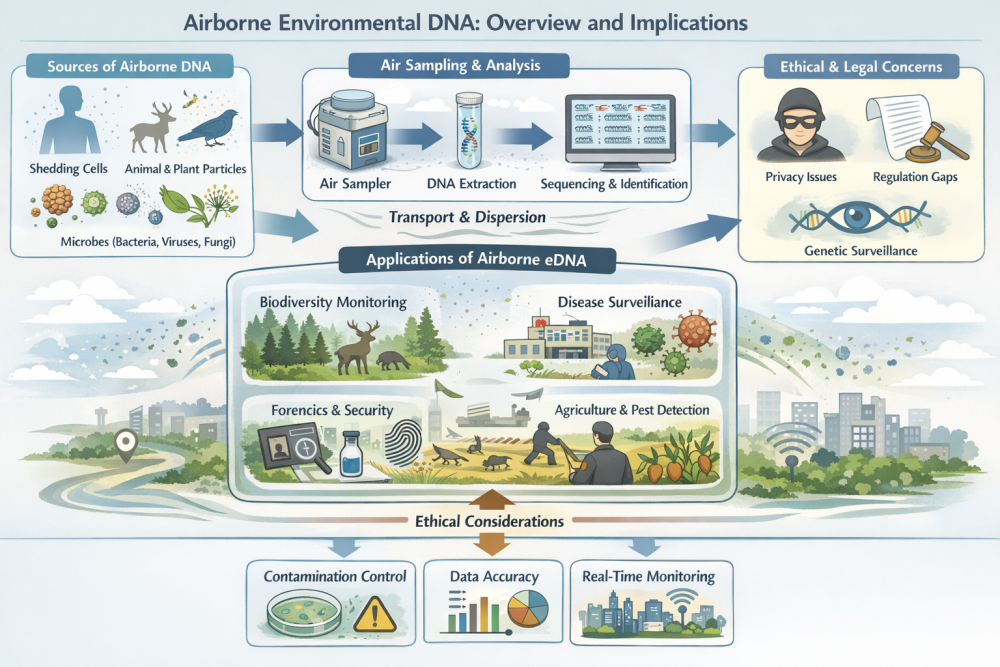
EH-11
Airborne environmental DNA (airborne eDNA) is an emerging frontier in molecular ecology, offering a non-invasive way to detect and monitor biological diversity across terrestrial and built environments. Recent advances show that DNA shed by organisms can persist in aerosols and be captured with air-sampling technologies, enabling the identification of taxa from microbes to vertebrates. This chapter synthesizes current knowledge on the origin, transport, and detection of airborne DNA; outlines methodological frameworks for sampling and analysis; and evaluates applications in biodiversity monitoring, epidemiology, and forensics. The chapter also critically examines the ethical, legal, and societal implications of inadvertent human genomic surveillance.
Keywords
Airborne environmental DNA; eDNA; molecular ecology; biodiversity monitoring; aerosolized DNA; metagenomics; bioaerosols; environmental surveillance; genetic privacy; forensic genomics
1. Introduction
The study of environmental DNA (eDNA) has revolutionized biological monitoring by enabling species detection from genetic material in environmental matrices such as water, soil, and sediments. Traditionally, ecological surveys relied on direct observation or physical capture of organisms, methods that are often labor-intensive, invasive, and limited in scope.
Recent breakthroughs have expanded this paradigm to include the atmosphere as a reservoir of genetic information. Airborne eDNA consists of microscopic biological particles, such as skin cells, pollen, spores, and microbial fragments, that are continuously emitted by living organisms and dispersed by air currents. Advances in molecular sequencing now allow researchers to recover and analyze these fragments, effectively transforming the air into a dynamic archive of biodiversity.
2. Sources and Dynamics of Airborne DNA
2.1 Biological Origins
Airborne DNA originates from a variety of biological processes:
- Shedding of epithelial cells from humans and animals
- Respiratory emissions, including droplets and aerosols
- Plant-derived material, such as pollen and leaf fragments
- Microbial dispersal, including bacteria, viruses, and fungal spores
These materials become aerosolized through natural processes (e.g., wind and evaporation) and anthropogenic activities (e.g., movement, agriculture, and urbanization).
2.2 Transport and Persistence
Atmospheric dynamics govern the distribution of airborne DNA:
- Wind patterns influence dispersal distance
- Humidity and temperature affect degradation rates
- Ultraviolet radiation contributes to DNA fragmentation
- Particle size determines suspension time
Airborne DNA can travel from local to regional scales, complicating the interpretation of its source. Despite degradation, short DNA fragments often remain sufficiently intact for taxonomic identification.
3. Methodological Approaches
3.1 Air Sampling Technologies
Airborne DNA is collected using filtration-based or impaction systems:
- High-efficiency particulate air (HEPA) filters
- Vacuum-based air samplers
- Passive dust collectors
Sampling duration, airflow rate, and environmental conditions significantly affect yield and representativeness.
3.2 DNA Extraction and Sequencing
Collected samples undergo laboratory processing:
- DNA extraction from filters using optimized protocols
- Amplification via polymerase chain reaction (PCR)
- High-throughput sequencing (e.g., metabarcoding, shotgun sequencing)
- Bioinformatic analysis for taxonomic assignment
The choice of genetic markers (e.g., mitochondrial or ribosomal) affects detection sensitivity and taxonomic resolution.
3.3 Data Interpretation Challenges
Key methodological challenges include:
- Contamination control (laboratory and environmental)
- Distinguishing local vs. distant sources
- Quantitative limitations in estimating organism abundance
- Incomplete reference databases
Standardization of protocols remains a critical need for reproducibility and comparability across studies.
4. Applications of Airborne eDNA
4.1 Biodiversity Monitoring
Airborne eDNA provides a non-invasive alternative to traditional ecological surveys:
- Detection of rare and elusive species
- Monitoring of ecosystem composition
- Early identification of invasive species
Studies have demonstrated successful detection of vertebrates in zoos, forests, and urban environments using air sampling alone.
4.2 Public Health and Epidemiology
The atmosphere serves as a conduit for microbial transmission. Airborne eDNA enables:
- Surveillance of pathogens in public spaces
- Early detection of disease outbreaks
- Monitoring of antimicrobial resistance genes
This approach has potential applications in hospitals, transportation hubs, and densely populated areas.
4.3 Agricultural and Environmental Management
Airborne DNA can support:
- Monitoring of crop pathogens
- Detection of pest species
- Assessment of pollinator presence
Such applications support sustainable agricultural practices and food security.
4.4 Forensic and Security Applications
The detection of human DNA in the air introduces novel possibilities:
- Reconstruction of recent human presence
- Supplementary evidence in forensic investigations
- Monitoring of occupancy patterns in built environments
However, these applications remain technically and ethically complex.
5. Ethical, Legal, and Social Implications
5.1 Privacy Concerns
The inadvertent collection of human genetic material raises significant concerns:
- Lack of informed consent
- Potential for genetic surveillance
- Risks of data misuse
Unlike traditional sampling, airborne DNA collection can occur without individuals' awareness or participation.
5.2 Regulatory Gaps
Existing legal frameworks are not fully equipped to address:
- Ownership of environmental genetic data
- Cross-border implications of airborne sampling
- Standards for data storage and sharing
There is an urgent need for international guidelines to govern the ethical use of airborne eDNA technologies.
5.3 Responsible Innovation
Balancing scientific advancement with ethical safeguards requires:
- Transparent research practices
- Stakeholder engagement
- Integration of ethical review processes
- Development of privacy-preserving methodologies
6. Limitations and Future Directions
6.1 Technical Limitations
- Low DNA concentrations in some environments
- Difficulty in linking DNA to specific individuals or populations
- Temporal variability in sampling results
6.2 Research Priorities
Future work should focus on:
- Improving sampling efficiency and sensitivity
- Developing quantitative frameworks
- Enhancing reference genomic databases
- Integrating multidisciplinary approaches (ecology, atmospheric science, bioinformatics)
6.3 Toward Routine Air Monitoring
The long-term vision includes:
- Continuous airborne DNA monitoring systems
- Integration with smart city infrastructure
- Real-time biodiversity and health surveillance networks
Such developments could transform environmental management and public health systems.
7. Conclusion
Airborne environmental DNA marks a paradigm shift in how biological information is accessed and interpreted. By enabling the detection of organisms through genetic traces in the air, this approach offers unprecedented opportunities for non-invasive monitoring across diverse domains.
However, its transformative potential is accompanied by significant ethical and regulatory challenges, particularly regarding human genetic privacy. The responsible advancement of airborne eDNA technologies will depend on interdisciplinary collaboration, robust methodological standards, and proactive governance frameworks.
As the field matures, airborne eDNA is poised to become an integral part of global efforts to monitor biodiversity, safeguard public health, and understand the complex dynamics of life on Earth.