Ecology and Human Health - Foundations for Environmental Science
Posted 6 months ago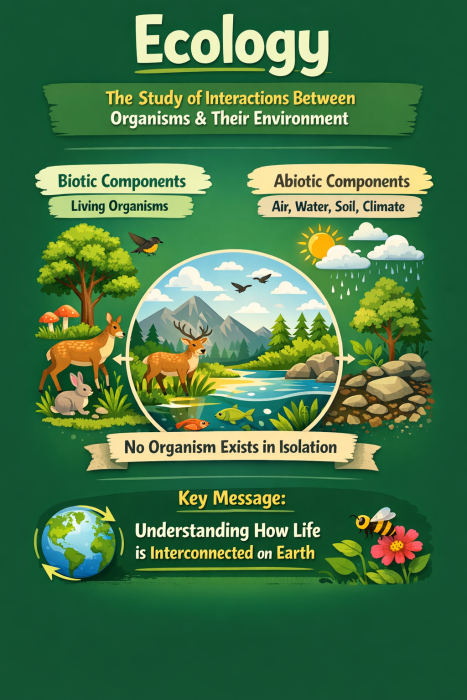
EH-8
1. Introduction
Ecology, from the Greek oikos (meaning "home") and logos (meaning "study"), is the scientific investigation of the interactions between organisms and their environment. It provides a framework for understanding how life survives, adapts, and evolves within complex natural systems. In Environmental Science, ecology is a fundamental discipline that provides crucial insights into the functioning of natural systems and how human actions impact them.
Human health depends on ecological processes. The air we breathe, the water we drink, and the food we eat all come from ecological systems. Therefore, understanding ecology is not just an academic topic; it is essential for maintaining human life and well-being.
2. Ecological Levels
Ecology examines interactions at multiple levels of biological organization:
• Organismal Ecology: How individual organisms respond to environmental conditions
• Population Ecology: Dynamics of species populations over time
• Community Ecology: Interactions among different species
• Ecosystem Ecology: Flow of energy and cycling of nutrients
A key ecological principle is that organisms interact not only with their physical environment (abiotic factors such as temperature, water, and soil) but also with other living organisms (biotic factors). These interactions shape where species live and how many there are worldwide.
3. Interconnected Among Living Organisms
One of ecology's most important insights is that no organism exists in isolation. Species are connected through:
• Food webs (energy transfer)
• Symbiotic relationships (mutualism, parasitism, commensalism)
• Competition and predation
These interactions form a web of life where changes in one part can ripple through the whole system. For example, losing pollinators can impact plant reproduction, food production, and ultimately human nutrition.
4. Ecology and Human Health
The relationship between ecology and human health is both direct and profound:
4.1 Ecosystem Services
Healthy ecosystems provide essential services:
• Essentials for Life: Food, fresh water, medicinal resources
• Regulating: Climate regulation, disease control, water purification
• Supporting: Nutrient cycling, soil formation
Disruption of these services can cause malnutrition, water shortages, and a higher disease burden.
4.2 Environmental Determinants of Health
Ecological conditions shape many health outcomes:
• Air quality → respiratory diseases
• Water quality → infectious diseases
• Biodiversity → regulation of disease vectors
For example, ecological imbalance can lead to a greater spread of vector-borne diseases like malaria and dengue, highlighting the importance of maintaining healthy ecosystems for human health.
4.3 Climate Change and Health
Global ecological changes, especially climate change, are shifting disease patterns, food security, and exposure to environmental hazards, creating major risks to human health worldwide.
5. Ecology within Environmental Science
While ecology focuses on understanding natural systems, environmental science extends this knowledge to address human-made environmental challenges. It integrates:
• Ecology (natural systems)
• Economics (resource allocation)
• Policy (governance and regulation)
• Ethics (sustainability and equity)
Thus, ecology provides the scientific foundation, while environmental science applies that knowledge to develop practical solutions to enhance environmental and human health.
6. Implications for Sustainable Living
Understanding ecology helps informed decision-making at individual, community, and policy levels.
• Promoting sustainable agriculture and food systems
• Conserving biodiversity
• Reducing pollution and resource overuse
• Designing healthier urban environments
A failure to consider ecological principles often results in unintended consequences that compromise both environmental integrity and human health.
7. Conclusion
Ecology reveals the fundamental truth that life on Earth is interconnected. Human health is deeply rooted in ecological systems, and disruptions to these systems inevitably impact our well-being. As students of environmental science, we recognize this interdependence as crucial for tackling the complex challenges of the 21st century.