FDA Approves Rasonque, a New Targeted Treatment for Advanced Pancreatic Cancer
Posted 1 month ago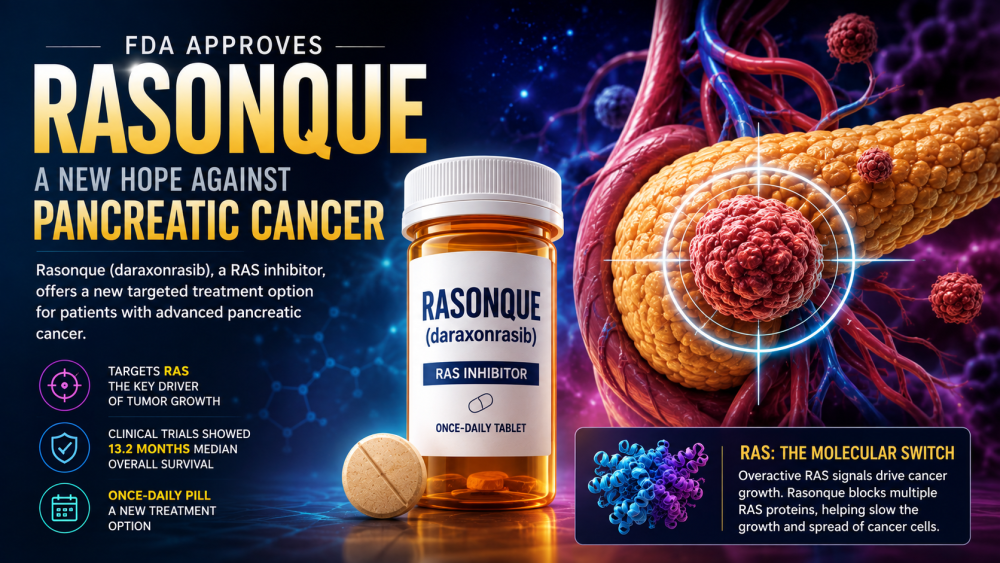
52/2026
The U.S. Food and Drug Administration has approved Rasonque (daraxonrasib), a once-daily tablet for adults with metastatic pancreatic adenocarcinoma, the most common pancreatic cancer. The approval offers patients with advanced pancreatic cancer another treatment option at a time when the disease remains among the most difficult cancers to treat.
Rasonque works by targeting RAS, a family of proteins that function as molecular switches inside cells. RAS normally helps regulate cell growth and division. In many pancreatic cancers, however, RAS mutations keep these growth signals switched on, encouraging cancer cells to multiply and survive. By blocking RAS signaling, Rasonque is designed to interfere with a key biological mechanism that drives tumor growth.
Encouraging survival results
The FDA's approval was supported by a randomized, open-label, multicenter clinical trial of 500 adults with previously treated metastatic pancreatic adenocarcinoma. According to the FDA, patients receiving Rasonque had a median overall survival of 13.2 months, compared with 6.7 months among those receiving standard chemotherapy.
Median survival is a statistical measure, meaning that half of the patients in a group lived longer. than that period and half lived for less. It does not predict how long an individual patient will survive. Nevertheless, the difference reported in the trial is significant because treatment options for metastatic pancreatic cancer are often limited.
Why pancreatic cancer is so difficult
Pancreatic cancer often develops without obvious early warning signs. Because the pancreas lies deep in the abdomen, tumors can grow for some time before detection. Approximately 90% to 95% of pancreatic cancers are pancreatic adenocarcinomas, which arise from the cells lining the pancreatic ducts. The National Cancer Institute estimates that about 67,000 new pancreatic cancer cases are diagnosed each year in the United States. The disease accounts for a disproportionately large share of cancer deaths because it is often diagnosed late, can spread rapidly, and has historically been difficult to control with available treatments.
A new approach to an old target
RAS has been a major focus of cancer research for decades. Scientists have long understood that abnormal RAS activity can help cancer cells grow, but developing medicines that effectively target the pathway has proved challenging.
Rasonque represents a new generation of drugs designed to attack this molecular machinery directly.
The approach reflects a broader shift in cancer medicine. Rather than treating cancer solely by its location in the body, researchers are increasingly developing treatments based on the specific molecular abnormalities that drive a tumor.
What does the FDA approval mean?
Approval does not mean Rasonque will work for every patient or that pancreatic cancer has been cured. Cancer cells can adapt to treatment, and resistance remains a major challenge for targeted therapies. Researchers will now continue studying how Rasonque performs over time, which patients benefit most, and whether combining RAS inhibition with other treatments could yield longer-lasting responses.
For patients facing advanced pancreatic cancer, however, the arrival of Rasonque marks an important development: a new way to attack a cancer that has remained remarkably difficult to treat.
Disclaimer
The contents provided on www.biomedglobal.org are intended for general informational and educational purposes only. This website's information, articles, and resources are based on data and findings from scientific publications, publicly available research, and reputable sources.
While every effort is made to ensure accuracy and reliability, Biomed Global does not guarantee, endorse, or assume responsibility for the completeness, timeliness, or validity of the information.
The material on this website should not be considered a substitute for professional advice, diagnosis, or treatment. Users are strongly encouraged to consult qualified healthcare professionals, researchers, or subject-matter experts before making decisions based on the information presented here.
Under no circumstances shall Biomed Global, its affiliates, contributors, or authors be held liable for any direct, indirect, incidental, or consequential damages arising from the use of, or reliance on, the content of this website.
By accessing and using www.biomedglobal.org, you fully acknowledge and agree to this disclaimer.