From Biological Data to Drug Discovery: Prof. Amer Jamil Launches New Online Course
Posted 1 month ago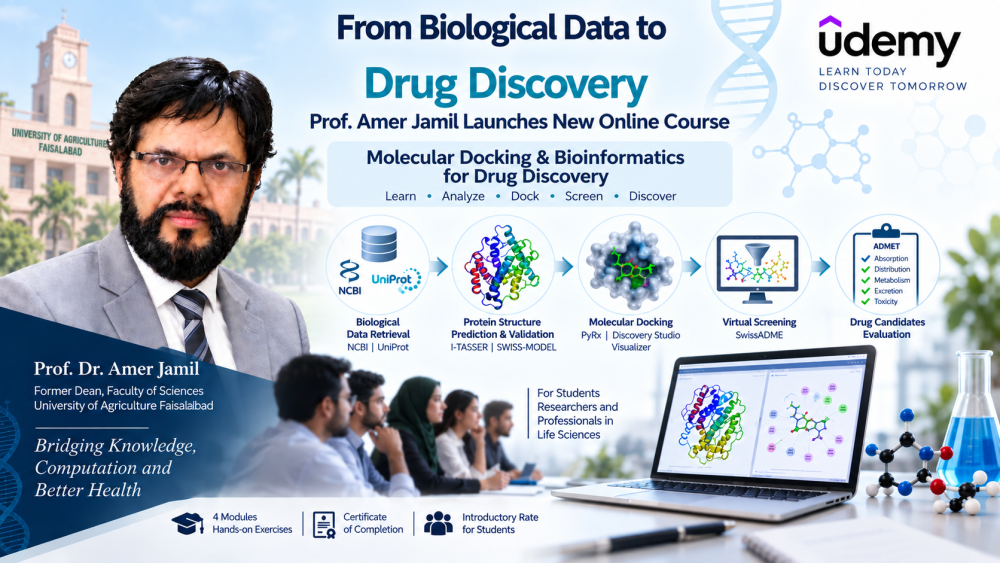
58/2026
Prof. Dr. Amer Jamil, former Dean of the Faculty of Sciences at the University of Agriculture Faisalabad, has launched a new online course that introduces students and early-career researchers to the computational tools increasingly shaping modern drug discovery.
Titled Molecular Docking & Bioinformatics for Drug Discovery, the course is now available on Udemy. It provides a structured, hands-on introduction to the computational drug-discovery pipeline, guiding learners from retrieving biological information to evaluating potential drug candidates.
Rather than treating bioinformatics software as a collection of isolated tools, the course follows the sequence in which computational methods are applied in biological and pharmaceutical research. Participants begin by retrieving biological data from the National Center for Biotechnology Information (NCBI) and UniProt, then proceed to protein structure prediction and validation using I-TASSER and SWISS-MODEL.
The course then turns to molecular docking, introducing practical workflows using PyRx and Discovery Studio Visualizer. The final stages cover virtual screening and ADMET (absorption, distribution, metabolism, excretion, and toxicity analysis) using SwissADME, providing learners with an overview of how computational approaches can assess and prioritize potential drug candidates.
The course was developed and recorded under Prof. Jamil’s academic supervision and reflects more than 35 years of experience in academic leadership, teaching, and research in biochemistry, molecular biology, and bioinformatics. According to him, “My goal was not simply to teach software tools, but to help learners understand how these methods are applied in real biological and pharmaceutical research.”
The four-module course is intended for a broad audience, including undergraduate, MSc, MPhil, and PhD students, as well as early-career researchers and professionals in biochemistry, biotechnology, pharmacy, molecular biology, bioinformatics, veterinary sciences, agriculture, botany, zoology, and related life-science disciplines.
The course's emphasis on practical exercises is particularly relevant as computational approaches become increasingly integrated into experimental research. Molecular docking, structural bioinformatics, virtual screening, and drug-candidate profiling are now widely used to help researchers investigate interactions between biological targets and potential therapeutic compounds before proceeding to more resource-intensive laboratory studies. The course includes hands-on exercises throughout its four modules and provides a certificate of completion. It is currently offered at an introductory rate, making it accessible to students and early-career researchers seeking to develop practical skills in computational drug discovery.
The initiative has also received appreciation from bioinformatics and biotechnology experts at home and abroad. Prof. Dr. Muhammad Mukhtar, Rector of the University of Southern Punjab, Multan, and Dr. Zahida Parveen, among other members of the scientific community, have welcomed the launch as a valuable contribution to contemporary life-sciences education. They praised Prof. Jamil’s efforts to make advanced computational approaches to drug discovery accessible through a practical, structured online format. They congratulated him on extending his decades of academic and research experience to a global community of learners.
Their recognition reflects a broader appreciation of the growing importance of bioinformatics, molecular modeling, and computational drug discovery in modern biological research. By bringing these techniques together in an accessible, hands-on course, Prof. Jamil is helping bridge the gap between established academic knowledge and the computational skills the next generation of researchers increasingly needs.
The launch adds another dimension to Prof. Jamil’s long academic career by extending his teaching and research into an online learning environment and making specialized training in molecular docking and bioinformatics available to a much wider international audience.