How a Self-Charging Toothbrush Could Transform Oral Healthcare?
Posted 22 hours ago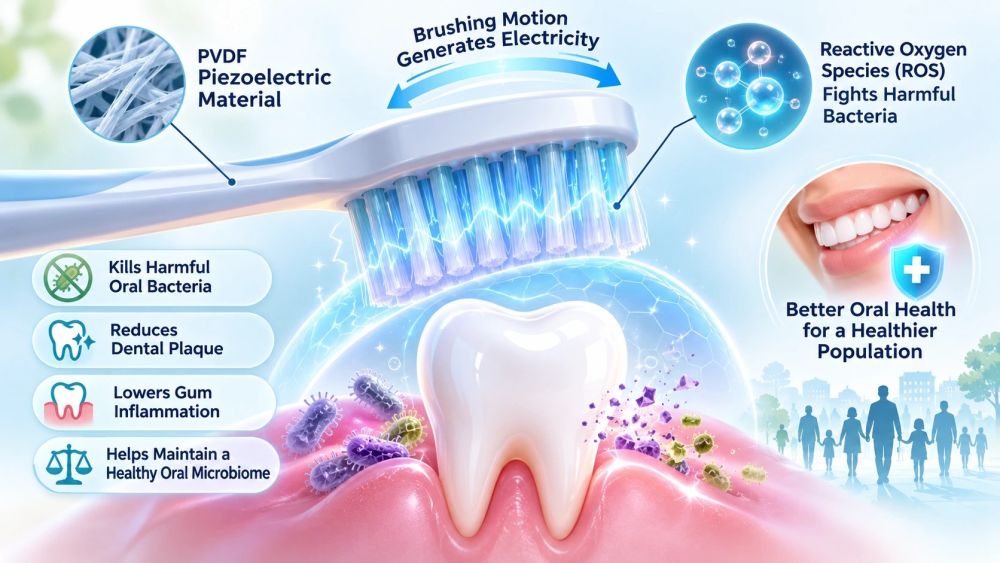
73/2026
Every morning, billions of people worldwide perform an almost identical ritual. They pick up a toothbrush, apply toothpaste, and spend two minutes brushing their teeth. It is one of the simplest acts of preventive oral healthcare, repeated so routinely that few of us ever stop to ask whether the toothbrush itself could be better.
For more than a thousand years, the basic principle has remained unchanged: bristles scrape away food particles and dental plaque through physical friction. Materials have improved, handles have become more sophisticated, and electric toothbrushes have entered the market. Yet the core approach has largely stayed the same.
Now, researchers may have found a way to change that, bridging the old model with what comes next.
A study published in Science Advances on November 4, 2026, and highlighted by Nature in its report, "Toothbrush zaps bacteria with electricity made when bristles move," describes a toothbrush that generates its own electrical activity through ordinary brushing. It requires no battery, charging cable, or external power source. Instead, it turns brushing into a way to fight harmful bacteria.
This is not merely an interesting improvement in bathroom technology. It also connects materials science, engineering, and preventive medicine.
When brushing becomes more than cleaning
The innovation revolves around a special polymer called polyvinylidene fluoride, or PVDF. This material belongs to a family known as piezoelectric materials, which generate electrical charges when subjected to mechanical pressure or deformation.
The principle is simple. As the toothbrush bristles bend and straighten during brushing, they generate electrical activity. This activity triggers chemical reactions in the surrounding moisture, producing highly reactive molecules known as reactive oxygen species (ROS).
Think of these molecules as microscopic agents that can damage bacterial structures. They attack bacterial membranes, interfere with essential cellular functions, and make it harder for harmful microorganisms to survive and attach to tooth surfaces.
Together, these two functions mean the bristles physically remove plaque while their electrically activated chemical activity helps suppress bacterial growth. Even when the toothbrush is not moving, its specially engineered surface retains an electrical potential that discourages bacterial attachment. In other words, the toothbrush does more than remove bacteria; it also makes the environment less hospitable for their return.
What did the researchers discover?
The research team investigated the technology against two important oral pathogens: Streptococcus mutans, commonly associated with tooth decay, and Porphyromonas gingivalis, a major contributor to periodontal disease.
Laboratory experiments demonstrated considerably stronger antibacterial effects than conventional nylon bristles. Depending on the bacterial species and the PVDF material used, the researchers reported antibacterial rates ranging from approximately 46 to 78 percent. Conventional nylon (control) showed substantially weaker effects. The findings became even more compelling when the researchers turned to dental plaque, a complex community of microorganisms that forms a protective biofilm on teeth.
In laboratory experiments involving human-derived plaque, the new toothbrush achieved more than 99 percent plaque removal under the tested conditions. But laboratory success alone does not establish a medical breakthrough, so the researchers moved on to a three-month clinical evaluation.
Of the 135 individuals screened, 115 participated. Participants were divided into groups using experimental PVDF toothbrushes and conventional nylon toothbrushes. Over the three months, users of the self-charged toothbrushes experienced significant reductions in dental plaque, gum inflammation, and gum bleeding. Researchers also observed changes in the oral microbial community. Harmful bacteria associated with dental decay and gum disease declined, while certain beneficial microorganisms increased.
This distinction is particularly important. Modern oral healthcare should not aim to eliminate every microorganism in the mouth. Our oral microbiome is a complex ecosystem, and many of its residents are essential for maintaining health. The real challenge is to control harmful organisms without unnecessarily disrupting beneficial ones.
A fascinating mechanism beneath the surface
The study also explains how technology works at the molecular level.
The electrically generated chemical reactions produce oxidative stress inside harmful bacteria. This damages their protective membranes and interferes with a cellular transport system known as the ATP-binding cassette, or ABC, transporter pathway. These transport systems help bacteria move essential substances across their membranes and survive. By disrupting this machinery, the technology makes it harder for certain harmful bacteria to function and persist.
Interestingly, the researchers found that some beneficial oral bacteria were less affected, suggesting that technology could help maintain a healthier microbial balance. This selective effect deserves further investigation because protecting the beneficial microbial community is just as important as controlling harmful bacteria.
An exciting discovery, but not yet the final answer
Scientific enthusiasm must always be balanced with scientific caution, especially when early results are promising. The clinical evaluation lasted only three months and involved a relatively limited number of participants. Longer studies with larger, more diverse populations will be needed to establish the durability and broader clinical benefits of this technology. The researchers themselves acknowledge that comparisons with commercially available electric, sonic and antimicrobial toothbrushes are still needed.
Questions also remain about manufacturing costs, commercial scalability, long-term safety and performance under everyday conditions involving saliva, food exposure and repeated bacterial recolonization. Most importantly, this innovation should not be interpreted as a replacement for established oral healthcare practices, including fluoride toothpaste, appropriate brushing techniques, flossing and regular dental examinations.
The future of everyday healthcare
Perhaps the most remarkable aspect of this discovery is not the toothbrush itself, but the thinking behind it, which points to a broader shift.
According to Prof. Emeritus Dr. Muhammad Mukhtar, Rector of the University of Southern Punjab, Multan, Pakistan and Editor-in-Chief of the Biomediglobal, we are entering an era in which ordinary materials can be engineered to perform functions previously associated with sophisticated electronic devices. As a result, material can respond to movement, generate electrical activity, and initiate chemical reactions without batteries or complicated circuitry. From there, the implications extend far beyond dentistry. Similar principles may eventually apply to antimicrobial surfaces, medical devices, wound management, and other areas of preventive healthcare.
In several parts of the world preventable dental diseases remain an important public-health concern, innovations that combine simplicity, affordability, and effectiveness deserve particular attention. If commercialized at an accessible price, such technologies could eventually benefit communities with limited access to advanced dental services.
The toothbrush has accompanied humanity for centuries. Perhaps its next transformation will be its most significant, as this small tool may take on a much larger role.
The lesson is both simple and profound: sometimes, the greatest technological revolutions do not begin with a new machine. They begin by looking at an everyday object and asking whether it could do something more.
Disclaimer
The contents provided on www.biomedglobal.org are intended for general informational and educational purposes only. This website's information, articles, and resources are based on data and findings from scientific publications, publicly available research, and reputable sources.
While every effort is made to ensure accuracy and reliability, Biomed Global does not guarantee, endorse, or assume responsibility for the completeness, timeliness, or validity of the information.
The material on this website should not be considered a substitute for professional advice, diagnosis, or treatment. Users are strongly encouraged to consult qualified healthcare professionals, researchers, or subject-matter experts before making decisions based on the information presented here.
Under no circumstances shall Biomed Global, its affiliates, contributors, or authors be held liable for any direct, indirect, incidental, or consequential damages arising from the use of, or reliance on, the content of this website.
By accessing and using www.biomedglobal.org, you fully acknowledge and agree to this disclaimer.