Mitochondria: New Research Reveals Clues to the Origins of Life and Future Treatments for Infectious Diseases
Posted 1 day ago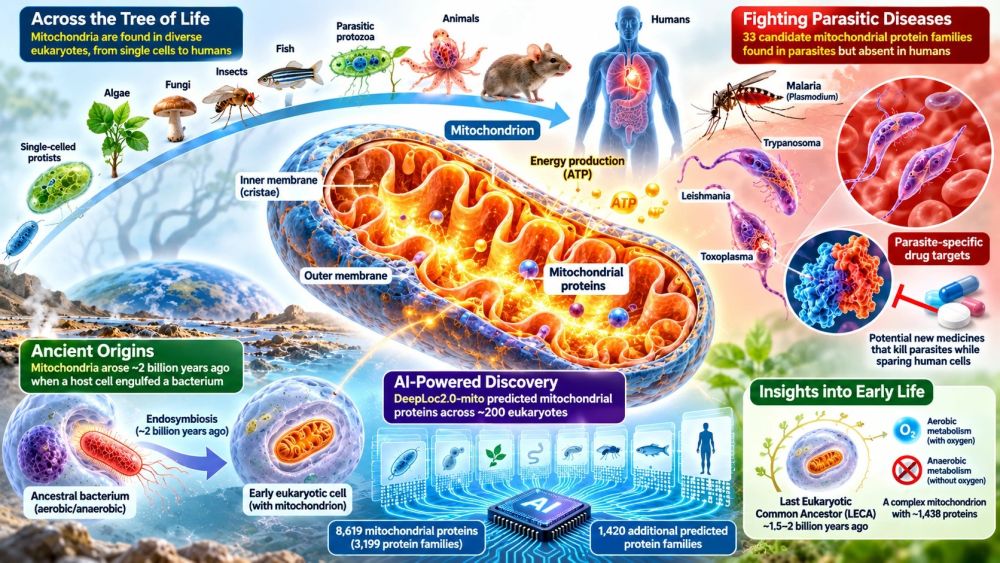
66/2026
Every cell in the human body depends on a remarkable internal structure called a mitochondrion. Often described as the cell’s powerhouse, mitochondria help convert nutrients into usable energy, enabling the heart to beat, the brain to function, and muscles to move. They also participate in other essential processes, including cellular communication and the regulation of cell survival.
Although biology students are familiar with mitochondria, their evolutionary history and full range of functions remain incompletely understood. They are thought to have originated about two billion years ago, when a host cell engulfed an ancient bacterium that eventually became a permanent cellular partner.
A study published in the prestigious journal Cell offers a much broader view of these remarkable structures. By comparing mitochondrial proteins across diverse organisms, the researchers identified potential new targets for treating parasitic diseases and reconstructed key mitochondrial features in ancient cells.
What did the scientists investigate?
The research team set out to answer three major questions:
- How have mitochondria changed across different forms of life?
- Can proteins found in disease-causing parasites but absent from humans provide new opportunities for developing safer treatments?
- What were mitochondria like in the earliest ancestors of modern complex cells?
To investigate these questions, the researchers experimentally examined mitochondrial proteins across eight organisms, including humans, yeast, a plant, and several single-celled parasites. They identified 8,619 mitochondrial proteins across 3,199 protein families.
The team then combined these experimental findings with advanced computational methods and artificial intelligence-based protein prediction to estimate mitochondrial protein inventories across approximately 200 additional eukaryotic organisms.
The scale of this comparison enabled the researchers to investigate mitochondrial evolution far beyond the handful of species traditionally studied in laboratories.
Major discoveries
1. New possibilities for treating parasitic diseases
The most immediate medical significance of this research is identifying 33 candidate mitochondrial protein families present in multiple disease-causing parasites but absent in humans.
These proteins may offer opportunities to develop medicines that attack parasites while sparing human cells. The researchers identified several particularly interesting candidates, including proteins involved in energy metabolism and cellular protein recycling.
In a previously published genetic screening study, the researchers identified three targets, ClpQ, class I fumarate hydratase, and a type of cardiolipin synthase, as essential in Plasmodium knowlesi. This strengthens the case for investigating them as potential drug targets.
Why does this matter? Parasitic diseases, including malaria and other protozoan infections, remain major public health challenges. Existing medicines can lose effectiveness as drug resistance develops. Identifying parasite-specific biological weaknesses could help researchers develop new treatment strategies.
However, these 33 targets are promising research candidates, not approved treatments. Scientists must still establish whether medicines can safely and effectively target them.
2. Artificial intelligence expands our understanding of mitochondria
The research team developed an improved computational model, called DeepLoc2.0-mito, using experimentally identified mitochondrial proteins to improve predictions of where proteins function within cells.
The model helped researchers predict mitochondrial protein families across 203 representative eukaryotic species, identifying 1,420 additional high-confidence mitochondrial protein families beyond those in the original experimental inventories.
This approach could help scientists investigate organisms that are difficult to grow in laboratories or study using conventional experiments.
The benefit extends beyond evolutionary biology. Improved predictions can help researchers select promising proteins for laboratory experiments, identify previously overlooked biological functions, and develop new hypotheses about disease-causing organisms.
3. A surprising picture of ancient life
One of the study’s most fascinating findings concerns the last eukaryotic common ancestor (LECA), the ancient organism from which all modern eukaryotes ultimately descend.
Using evolutionary comparisons and computational reconstruction, the researchers estimated that LECA lived about 1.5–2 billion years ago and had a complex mitochondrion with an estimated 1,438 proteins, though the estimate has substantial uncertainty.
The reconstructed mitochondrion appears to have supported both aerobic metabolism, which uses oxygen, and anaerobic metabolism, which can proceed without oxygen.
This suggests that early complex cells may have had greater flexibility in energy production than a simple oxygen-dependent model would imply. The researchers also found evidence supporting the idea that mitochondria emerged relatively late in the development of complex eukaryotic cells, after several other cellular structures had already evolved.
These findings help explain how cells adapted to changing environmental conditions over evolutionary time.
What are the potential benefits for society?
The study offers several important avenues for future research:
- New antiparasitic medicines: Candidate targets may guide the development of treatments for malaria and other protozoan infections.
- Potentially greater drug selectivity: Targets absent in humans may offer opportunities to reduce harm to human cells, although safety must be demonstrated experimentally.
- Better use of AI in biology: Improved protein prediction can accelerate research into poorly understood organisms.
- A deeper understanding of mitochondrial disease: Identifying ancient, conserved mitochondrial functions may help researchers investigate the biological roles of proteins linked to human mitochondrial disorders.
- New approaches to plant protection: The study also identified candidate mitochondrial targets shared by multiple plant pathogens yet absent in a representative land plant, potentially informing future crop-protection research.
Important limitations
The authors acknowledge that evolutionary reconstruction depends on available genome sequences, computational predictions, and assumptions about ancient relationships. Some protein families remain poorly understood, and the estimated composition of ancestral mitochondria is uncertain.
Most importantly, identifying a protein that differs between a pathogen and humans does not automatically mean that it can be safely or effectively targeted with a drug. Further laboratory testing, drug development, and clinical trials will be necessary.
Conclusion
This study marks an important advance in understanding mitochondria across the diversity of life. By combining experimental biology, computational analysis, and artificial intelligence, the researchers have created a broader picture of how these essential cellular structures evolved and diversified.
Its most immediate practical promise lies in the discovery of 33 candidate protein families that could guide future anti-parasitic drug development. Its broader scientific value lies in revealing how ancient cells may have produced energy and how mitochondrial functions have evolved over billions of years.
The central message is that studying life's evolutionary diversity can reveal new opportunities for modern medicine. What scientists learn today from microscopic organisms and ancient cellular systems may help them design better treatments for infectious diseases tomorrow.