Rector USP Virtually Joins Global Launch of Report on Early Childhood and Education on World Children’s Day 2026 “My Day, My Rights, My Future."
Posted 1 day ago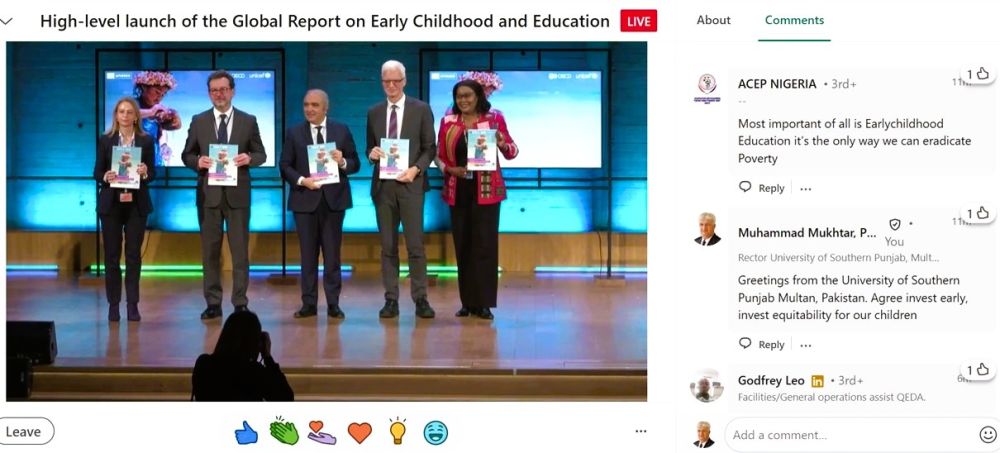
81/26
Childhood is the foundation upon which the future of individuals, societies, and civilizations is built. Yet millions of children worldwide continue to be deprived of quality education, essential care, and opportunities for healthy development because of poverty, inequality, and inadequate public investment. This was the central message during the global launch of the Global Report on Early Childhood Care and Education 2026: Financing for Equity, Inclusion and Quality, which Prof. Emeritus Dr. Muhammad Mukhtar, rector of the University of Southern Punjab (USP), Multan, Pakistan, participated in on World Children’s Day.
The landmark report, jointly published by UNESCO, UNICEF, and the OECD, presents a compelling assessment of global investment in early childhood care and education (ECCE), exposing significant disparities in financing, access, and quality. It calls upon governments and development partners to invest more, invest earlier, and invest fairly to ensure that every child receives the opportunities necessary to flourish.
Sharing his reflections, Prof. Mukhtar emphasized that childhood happens only once and no child should be deprived of its promise because of their family's economic circumstances. He observed that millions of families struggle to meet basic needs while their children face barriers to learning, development, protection, and a fulfilling childhood. Such challenges demand a collective response from governments, educational institutions, communities, and international development organizations.
The 2026 Global Report reveals that despite a 45% increase in early childhood education enrolment since 2000, public investment remains inadequate, unevenly distributed, and often arrives too late.
One of its most striking findings is that 76 low- and lower-middle-income countries will require approximately US$69 billion annually between 2027 and 2030 to achieve their pre-primary education targets while maintaining minimum quality standards. However, projected public financing will cover only about half of these requirements, leaving an estimated annual financing gap of US$35 billion.
Governments currently spend less than 0.5% of their GDP on pre-primary education, reflecting persistent underinvestment in the earliest years of life. Children under six make up about one-third of the global child population but receive only 16% of child-related public expenditure across education, health, and social protection. No region allocates over 30% of its child-related spending to this age group.
The report also highlights profound inequalities tied to geographical and socioeconomic circumstances. Based on purchasing-power-adjusted estimates, public expenditure per child under six is more than 80 times higher in Europe and North America than in sub-Saharan Africa.
An especially important finding concerns children under three, who remain largely overlooked in public financing and early childhood development programs. Across 87 countries with comparable data, only 18% of children from birth to age three participate in early childhood education and development programs.
The report also finds that about four in ten children aged two to four do not receive enough responsive interaction or stimulation at home. These interactions, including reading, storytelling, singing, and drawing with caregivers, are essential for cognitive, social, and emotional development.
These findings reinforce the importance of recognizing early childhood development as a comprehensive human development priority, not just through the lens of formal schooling.
Five Priorities for Transforming Early Childhood Education
The report identifies five strategic priorities for governments and development partners:
- Invest earlier and secure long-term financing: Protect dedicated early childhood education allocations and ensure sustained, multi-year investment.
- End the financing blind spot for children under three: Expand integrated services covering health, nutrition, responsive caregiving, early learning, and early intervention.
- Strengthen multisectoral coordination: Establish a government-led system that connects education, health, nutrition, and social protection.
- Invest in the early childhood workforce: Ensure qualified, fairly compensated and professionally supported educators and caregivers.
- Prioritize inclusion and affordability: Direct resources towards disadvantaged children, provide targeted subsidies and reduce the financial burden on families.
The report also notes that only 34 of 67 countries with available data meet the Tashkent benchmark of allocating at least 10% of education expenditure to pre-primary education, showing the considerable gap between international commitments and implementation.
Investing in Children Is Investing in Humanity
The report reminds us that educational inequalities begin long before children enter primary school. Addressing these inequalities requires early intervention, equitable financing, family support, and a strong commitment to every child's dignity and rights.
Concluding his World Children’s Day message, Prof. Mukhtar emphasized that investing in children today means investing in a more peaceful, knowledgeable, compassionate, and equitable society tomorrow.
His message resonates with the report's powerful global call: "Invest more. Invest earlier. Invest fairly. Make every child count."
Because childhood cannot be repeated, the responsibility to protect it cannot be postponed.