The Brain’s Security Gate: How the Blood–Brain Barrier May Influence Alzheimer’s Disease
Posted 19 hours ago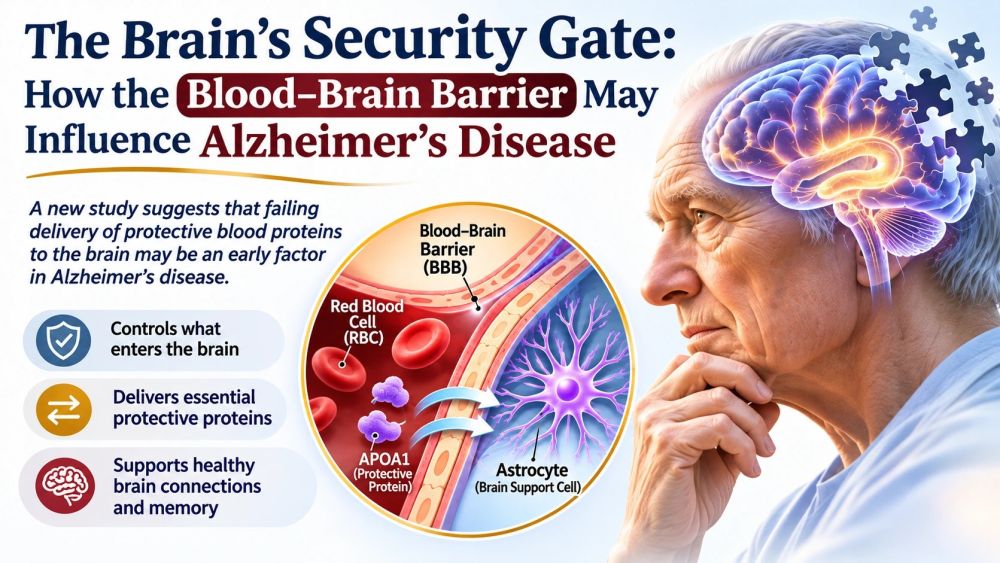
77/2026
A study has found that impaired transport of protective blood proteins into the brain may be a factor in the early stages of Alzheimer's disease, which could have significant implications for future therapies.
For millions of families across the world, Alzheimer's is one of the most difficult health problems we face in modern times. It's a disease of progressive memory loss, of increasing difficulty in recognizing people you know, of increasing difficulty in carrying out the most basic of tasks. Scientific discoveries have helped us in our understanding of the disease, but the earliest biological changes are still not fully understood.
Now, an exciting scientific discovery may well change the way we think about the disease. The study, published in the journal Cell (highlighted in Nature Journal on 11 November 2026), suggests that Alzheimer's may start with a rather bizarre problem: the brain losing access to certain protective proteins present in the blood.
This raises a new possibility for how the disease might develop and could ultimately lead to novel approaches for both prevention and treatment.
The Brain Has Its Own Security System
To understand this discovery, we first need to understand how the brain protects itself.
The human brain is an incredibly delicate organ. Unlike other tissues, it can't just let everything in the blood get through. It has a sophisticated protective structure called the blood-brain barrier (BBB).
Think of this barrier as a very sophisticated security checkpoint around the brain, controlling exactly what gets in and what must stay out. It permits essential nutrients and certain molecules to pass while blocking many noxious substances, toxins, and infectious agents.
For a long time, the blood-brain barrier was seen as a protective wall, and its breakdown was thought to be implicated in several neurological diseases. In Alzheimer's disease, for instance, it's been observed that the blood-brain barrier can be damaged and that this may allow the entry of harmful substances into the brain.
However, the new research points to another side of the story.
The blood-brain barrier doesn't just keep unwanted stuff out. It also actively transports essential proteins from the blood into the brain to help maintain brain cell health. When this delivery system fails, the repercussions may start much earlier than we thought.
Researchers developed a new lab technique to identify proteins in the blood and determine which can cross the blood-brain barrier. They looked at 861 different proteins and found 92 that could enter the brain. Interestingly, many of these proteins were produced outside the brain (in the liver).
This is a very important point, really: the health of the brain is not just a function of what's going on in the brain. It also depends on proteins and other essential substances provided by organs distant from the brain. Among the proteins studied, one stood out: apolipoprotein A1 (APOA1). This protein is well known for its role in cholesterol transport and metabolism and is also associated with potentially protective effects against Alzheimer's disease. The researchers found that APOA1 can enter the brain and stimulate astrocytes. Astrocytes are star-shaped support cells that perform several vital functions, including maintaining the environment around neurons and supporting communication between neurons.
Among several others, a key function of astrocytes is regulating cholesterol, which is required to maintain synapses (the small connections through which neurons communicate). Without healthy synapses, the brain's ability to process information, store memories, and coordinate its activities declines.
An Unexpected Early Problem in Alzheimer’s Disease
The key finding came when they looked at mice that had been engineered to develop the characteristics of early Alzheimer's disease. Scientists have long linked the progression of Alzheimer's with the breakdown of the blood-brain barrier, permitting harmful substances into the brain. However, the new study found a different sequence of events. In a mouse model, the barrier began losing its ability to transport protective proteins (including APOA1) into the brain before the barrier itself became leaky.
In other words, the brain seemed to lose access to some of its natural protective stores before its security system actually failed. This disruption of the blood-brain barrier that follows was associated with several concerning changes, including:
• Loss of connections between neurons.
• Abnormal accumulation of fat within the astrocytes.
• Increased inflammatory activity in the brain.
• Changes in behavior which may resemble the features of a neurological disease.
These observations point to impaired protein trafficking as a potentially very significant early contributor to brain dysfunction. They also raise the question of whether restoring the supply of protective proteins might help preserve brain health.
A Promising Experiment: Increasing APOA1 Production
To explore that possibility, scientists performed another experiment.
They created Alzheimer's model mice genetically engineered to produce extra APOA1 in their livers. The liver was an interesting target, as it's one of the major organs responsible for producing proteins present throughout the body. The results were encouraging. With increased APOA1 production, more of the protein crossed the blood-brain barrier and entered the brain.
The treated mice subsequently showed fewer biological features associated with Alzheimer's. They showed less abnormal fat accumulation in astrocytes and lower levels of inflammatory molecules.
This experiment provides important proof of concept: increasing the availability of protective protein in the blood may affect processes within the brain. However, it is vital to stress that these were mouse experiments. They in no way establish that increasing APOA1 in humans will prevent Alzheimer's or reverse memory loss.
Human clinical studies will be required to establish whether this approach is safe and effective.
Could this discovery change the way we treat Alzheimer's in the future?
Alzheimer's disease affects millions of people globally and is a major public health issue of increasing concern as our populations age. We do have some treatments available now that can help (medicines that manage symptoms, and new therapies that target the disease itself). There's still a very real need for approaches that can identify and intervene at the very earliest biological level.
The new findings point to several interesting research avenues.
1. Protecting the brain’s protein delivery system
Future therapies may aim to preserve the blood-brain barrier's ability to allow essential proteins into the brain.
2. Exploring APOA1-based therapies
Scientists may explore whether APOA1 or related molecules can be developed into therapies that promote neuronal health and reduce damaging inflammation.
3. Developing earlier diagnostic approaches
If protein transport is impaired before significant neurological damage occurs, researchers may one day identify biomarkers that allow them to detect disease-related changes earlier.
4. Understanding the relationship between different organs
The finding reinforces the importance of communication between the liver, blood, and brain. It may lead to further work on how liver health and circulating proteins affect neurological health.
What does this mean for the ordinary person?
Although it's a scientifically exciting discovery, it's not a reason to buy APOA1 supplements, start cholesterol meds, or change your current treatment. At this stage, there is no established clinical evidence that increasing APOA1 via supplements or lifestyle interventions will prevent Alzheimer's disease. Nevertheless, the study reminds us that brain health is linked to overall body health.
Maintaining cardiovascular and metabolic health (i.e., controlling blood pressure and diabetes), staying physically active, eating a healthy diet, getting sufficient sleep, and remaining socially and mentally engaged are all sensible ways to support long-term brain health.
People with ongoing memory problems should have them properly assessed by a doctor rather than just accepting that this is simply a normal part of aging.
A New Chapter in Understanding Alzheimer’s Disease
Perhaps the most striking thing about this work is the shift in scientific thinking that it embodies.
For years, the bulk of Alzheimer's research has been focused on the toxic substances that accumulate in the brain and the damage they do to the neurons. The new findings point to another key element of the story: the brain may be missing essential protective proteins that normally come via the blood. It's a reminder that human health is about more than just getting rid of the bad stuff. It's also about making sure the biological systems that support life keep working.
The research is still in the very early experimental stages, and there's a long way to go before we can translate these findings into any human therapy. It does, however, represent a very promising new avenue in the global quest to understand, prevent, and ultimately treat Alzheimer's disease.
Sometimes the key to protecting the brain may not be preventing the bad stuff from getting in, but making sure the good stuff never stops getting in.
Disclaimer
The contents provided on www.biomedglobal.org are intended for general informational and educational purposes only. This website's information, articles, and resources are based on data and findings from scientific publications, publicly available research, and reputable sources.
While every effort is made to ensure accuracy and reliability, Biomed Global does not guarantee, endorse, or assume responsibility for the completeness, timeliness, or validity of the information.
The material on this website should not be considered a substitute for professional advice, diagnosis, or treatment. Users are strongly encouraged to consult qualified healthcare professionals, researchers, or subject-matter experts before making decisions based on the information presented here.
Under no circumstances shall Biomed Global, its affiliates, contributors, or authors be held liable for any direct, indirect, incidental, or consequential damages arising from the use of, or reliance on, the content of this website.
By accessing and using www.biomedglobal.org, you fully acknowledge and agree to this disclaimer.