A New Hope in the Fight Against HIV - Lenacapavir
Posted 10 hours ago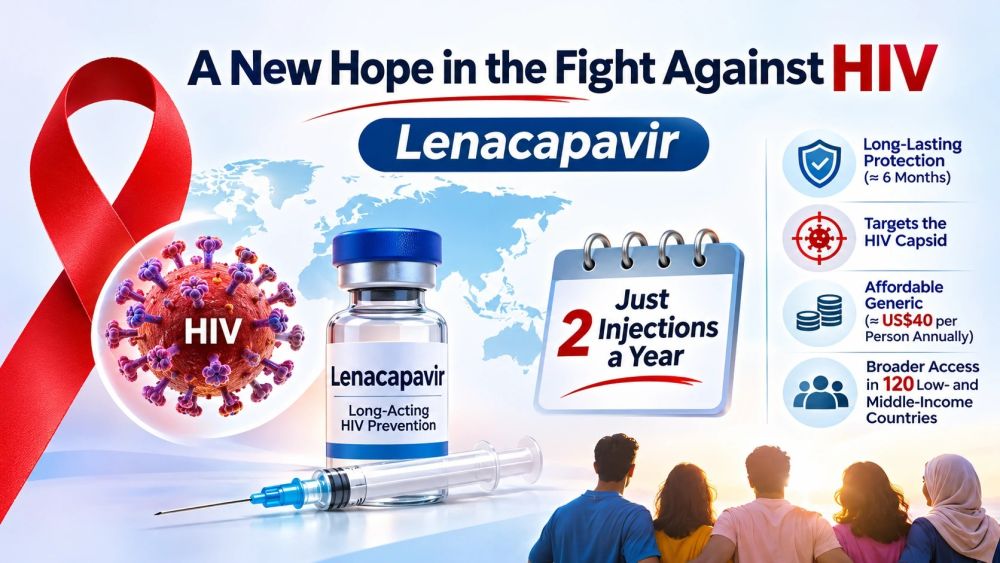
71/2026
For more than four decades, HIV (Human Immunodeficiency Virus) has remained one of the world's most persistent public-health challenges. Although refinements in antivirals have transformed HIV infection from a frequently fatal disease into a manageable chronic condition, preventing new infections remains a global priority. Now, a remarkable scientific development offers renewed hope for that effort: a medicine that can protect people against HIV with just two injections a year.
The medicine, lenacapavir, developed by Gilead Sciences, represents a new generation of long-acting antiviral drugs. Unlike conventional HIV-prevention medicines, which require daily tablets, lenacapavir is administered by injection approximately every six months. This dosing schedule could transform prevention for individuals who struggle with daily medication, have limited access to healthcare, or face stigma associated with taking preventive drugs.
Understanding Science
HIV attacks the body's immune system, particularly CD4 T lymphocytes, which coordinate immune responses. Without effective treatment, the virus progressively weakens immunity and can eventually lead to AIDS (Acquired Immunodeficiency Syndrome).
Lenacapavir works through a distinctive mechanism. It targets the HIV capsid, a protective protein structure surrounding the virus's genetic material. By disrupting the capsid, lenacapavir interferes with several stages of the viral life cycle, making it difficult for HIV to establish infection.
Importantly, lenacapavir is not a vaccine. Rather than stimulating the immune system, it directly interferes with the virus's biological machinery. Its long-lasting activity maintains protective drug concentrations in the body for approximately six months.
FDA Decision for Making the Treatment Available
Perhaps the most consequential development came in November 2026, when the US Food and Drug Administration (FDA) granted tentative approval to a generic version of injectable lenacapavir manufactured by India's Dr. Reddy's Laboratories. Of importance, the generic version cannot be marketed in the US market.
That development was facilitated through collaboration involving Unitaid, the Clinton Health Access Initiative, and South Africa's Wits RHI. As a result, the generic manufacturer has pledged to make the medicine available for approximately US$40 per person annually, potentially extending access to 120 low- and middle-income countries.
The significance becomes clearer when compared with the branded product. Gilead's lenacapavir, marketed in the United States as Yeztugo, received FDA approval in June 2025 for HIV prevention. By contrast, its US list price is approximately US$28,218 annually for two injections providing a year's protection.
A significant difference between $28,218 and $40 shows the extraordinary potential of generic pharmaceutical manufacturing to make advanced medical technologies accessible to the populations that need them most.
The FDA's generic approval is technically designated as tentative because the original product remains protected by patent. Even so, this regulatory milestone can accelerate approval processes in other countries and facilitate access to affordable, quality-assured medicines.
Historically, the World Health Organization (WHO) recognized the importance of this development in July 2025, recommending twice-yearly injectable lenacapavir as an additional HIV prevention option.
This recommendation reflects an important principle of modern public health: prevention strategies must accommodate different needs and circumstances. Some individuals may prefer daily tablets, while others may find long-acting injections more convenient, discreet and acceptable.
A New Chapter in Global Health
The history of medicine shows that a single discovery rarely overcomes major public health challenges. Instead, success requires scientific innovation, affordable technologies, effective healthcare systems, and sustained international cooperation.
Lenacapavir represents more than a convenient pharmaceutical formulation. It shows how advances in molecular biology and antiviral drug development can reshape disease prevention. Its greatest promise lies not simply in its impressive clinical results, but in the possibility of making protection accessible to millions of people who have historically been underserved.
The ultimate challenge is to ensure that poverty, geography and social stigma do not determine who benefits from scientific progress. That challenge now shapes how we should understand this breakthrough.
Two injections a year may seem like impressive medical intervention. Even so, they could represent a giant step towards a world in which HIV prevention is simpler, more affordable and accessible to everyone. Science has opened a new door; global cooperation must now ensure that no one is left behind.
Disclaimer
The contents provided on www.biomedglobal.org are intended for general informational and educational purposes only. This website's information, articles, and resources are based on data and findings from scientific publications, publicly available research, and reputable sources.
While every effort is made to ensure accuracy and reliability, Biomed Global does not guarantee, endorse, or assume responsibility for the completeness, timeliness, or validity of the information.
The material on this website should not be considered a substitute for professional advice, diagnosis, or treatment. Users are strongly encouraged to consult qualified healthcare professionals, researchers, or subject-matter experts before making decisions based on the information presented here.
Under no circumstances shall Biomed Global, its affiliates, contributors, or authors be held liable for any direct, indirect, incidental, or consequential damages arising from the use of, or reliance on, the content of this website.
By accessing and using www.biomedglobal.org, you fully acknowledge and agree to this disclaimer.