AI-Engineered Viruses: A Medical Revolution Viewed Through the Lens of COVID-19
Posted 7 months ago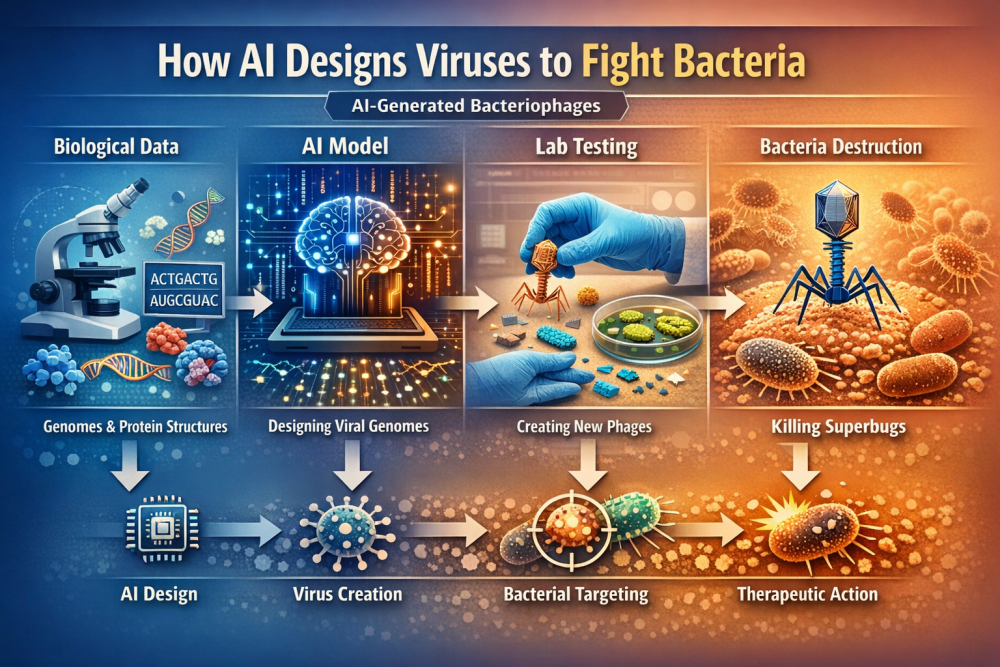
14/2026
In laboratories around the world, scientists are beginning a remarkable new chapter in biology in which artificial intelligence can design viruses from scratch, potentially offering new solutions to combat antibiotic-resistant infections and transform medicine.
At first glance, the idea of designing viruses might seem alarming. However, the viruses being created are not meant to harm humans. Instead, they are bacteriophages, often called phage viruses, that specifically infect and destroy bacteria, serving as precise tools against resistant microbes.
The Growing Threat of Antibiotic Resistance
Antibiotics revolutionized medicine in the twentieth century, saving millions of lives. However, bacteria evolve rapidly. Through decades of antibiotic overuse and misuse, many microbes have become resistant to the drugs meant to kill them. Today, antibiotic-resistant infections are among the biggest global health threats.
Pathogens like certain strains of Escherichia coli and other bacteria are becoming harder to treat. Doctors sometimes encounter infections with no effective antibiotics left. This alarming trend has prompted scientists to seek new strategies.
One promising solution is phage therapy, the use of bacteriophages to target bacteria. Unlike broad-spectrum antibiotics, phages are highly specific. Each type of phage typically attacks only certain bacterial strains, leaving beneficial microbes unharmed.
But finding the right phage for a specific infection can be difficult. Nature has billions of phages, yet identifying the most effective one for a particular bacterium is like searching for a needle in a haystack.
This is where artificial intelligence enters the story, offering a solution to the challenge of identifying effective phages among billions of natural variants.
When Artificial Intelligence Meets Biology
Modern AI systems excel at detecting patterns in large datasets. Recently, researchers have started training AI models on extensive collections of biological sequences, DNA, RNA, and protein structures.
These models learn the “language” of life, much like language models learn grammar and vocabulary. Instead of predicting words, however, they can forecast DNA sequences and biological structures.
Scientists recently used such AI tools to design entirely new viral genomes—essentially writing genetic instructions for viruses that had never existed before. The AI analyzed known bacteriophage genomes and learned how their genetic components interact.
Using this knowledge, the system generated new genome sequences predicted to work as viable phages. Researchers then synthesized these genomes in the lab and tested them against bacteria.
Remarkably, some AI-generated viruses successfully infected and killed E. coli bacterial strains, demonstrating that machine-designed genomes can produce functional viruses.
This achievement marks a significant milestone in synthetic biology: the ability to create living biological entities using computational models.
From Random Discovery to Intelligent Design
Traditionally, discovering useful bacteriophages has depended on environmental sampling, collecting water or soil, and screening for naturally occurring phages. The process can be slow and unpredictable.
AI shifts the paradigm. Instead of unthinkingly exploring nature, scientists can now engineer viruses with specific traits.
For example, researchers could instruct AI systems to:
- Target particular bacterial pathogens
- Avoid resistance mechanisms
- Adapt to specific environments in the human body
- Deliver therapeutic molecules
The technology enables scientists to shift from discovering biology to designing biology.
This approach could significantly accelerate the development of phage therapies, particularly for hospitals facing rising rates of antibiotic-resistant infections.
A Step Toward AI-Generated Life
The successful development of AI-designed viruses signifies more than just a medical breakthrough. It also indicates a wider shift in how life itself might be engineered in the future.
Scientists have long been able to modify genes or edit DNA. However, AI-driven design introduces a new ability: creating completely new biological systems that evolution has never developed.
Increased collaboration between humans and AI in designing biological systems fosters optimism about innovative solutions and shared scientific progress.
Although the current work focuses on bacteriophages, similar approaches could eventually be used to design:
- Enzymes that break down plastic waste
- Microbes that capture carbon dioxide
- Viruses that deliver gene therapies
- Synthetic organisms for medicine and agriculture
The potential applications are vast, spanning healthcare, environmental science, and biotechnology.
Safety and Ethical Considerations
Despite its promise, AI-driven biology requires careful oversight to ensure safety and ethical integrity. Emphasizing responsible development can reassure the audience about the technology's benefits and risks.
Researchers and policymakers are concerned about issues such as:
- Biosecurity risks if the technology is misused
- Regulation of synthetic organisms
- Ethical Limits in Creating Artificial Life
Most scientists stress that responsible governance must develop alongside technological advances. Robust safety standards, openness, and global cooperation are vital to guarantee these tools serve humanity well.
The rise of artificial intelligence-aided genome design opens exciting opportunities in biotechnology, but it also brings valid concerns about biosafety and public perception. Renowned virologist Prof. Dr. Muhammad Mukhtar explains that the recent COVID-19 pandemic shows how easily scientific progress can be mixed with misinformation and conspiracy theories. During the pandemic, widespread claims asserted that SARS-CoV-2 was a synthetic virus, despite no credible scientific evidence to support this claim. This speculation highlights the need to approach new technologies such as AI-designed viruses or synthetic biological systems with caution, transparency, and a solid scientific basis.
Mukhtar stresses that while these innovative tools can improve medicine and biotech, they must be carefully evaluated through rigorous biosafety, biosecurity, and ethical standards to avoid misunderstanding, misuse, or loss of public trust. Responsible governance, open scientific dialogue, and international cooperation will be crucial to ensuring that emerging technologies benefit humanity while reducing risks.
The Future of Medicine and Biotechnology
For decades, scientists have dreamed of programmable biology—the ability to design living systems as easily as engineers design machines. AI-generated viruses are among the first concrete steps toward that vision.
If developed responsibly, this technology could revolutionize the fight against infectious diseases. Hospitals might one day use custom-designed phages to eradicate dangerous bacteria within days, instead of relying on antibiotics that may fail.
Broadly, the integration of artificial intelligence and synthetic biology could transform how humans connect with the living world. Instead of just studying nature, we are now designing and modifying it with unmatched precision.
Disclaimer:
The contents provided on www.biomedglobal.org are intended for general informational and educational purposes only. This website's information, articles, and resources are based on data and findings from scientific publications, publicly available research, and reputable sources.
While every effort is made to ensure accuracy and reliability, Biomed Global does not guarantee, endorse, or assume responsibility for the completeness, timeliness, or validity of the information.