Atmospheric Layers and Their Significance in Environment and Health
Posted 7 months ago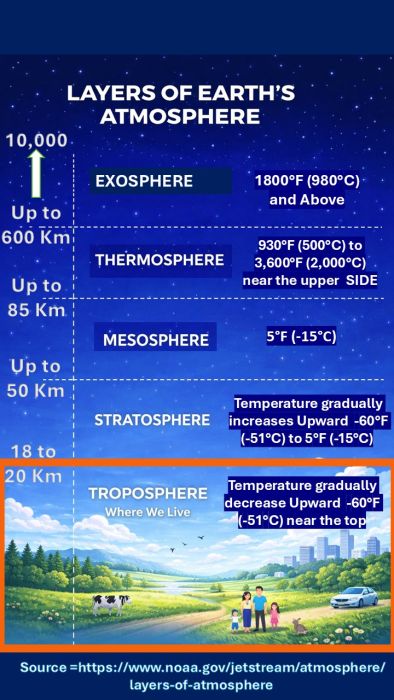
EH-4
The atmosphere is a vast, invisible layer of gases surrounding Earth that supports life, inspiring a sense of appreciation and responsibility in the audience. It functions as a protective shield, a temperature regulator, and a medium for biological and chemical interactions essential for human survival. It helps maintain temperature, enables weather systems, and shields living organisms from harmful solar radiation.
The atmosphere is more than just a physical barrier; it's a vital life-support system that directly influences air quality, climate change, and disease spread, impacting both human health and ecosystems. Understanding how layers such as the troposphere and stratosphere affect these factors clarifies their importance for environmental and health outcomes.
Scientists classify the atmosphere into five main layers based on temperature, density, and composition:
Troposphere, Stratosphere, Mesosphere, Thermosphere, and Exosphere.
Basis of Atmospheric Layering
The atmosphere is layered mainly because of temperature differences. As altitude rises, temperature can decrease, increase, or change unpredictably depending on the layer. This variation helps set boundaries such as the tropopause, stratopause, and mesopause.
Additionally:
• Air pressure and density decline as altitude increases.
• Solar radiation absorption varies across layers.
• Chemical composition varies with height
This stratification is critical for maintaining environmental balance and supporting life.
The Troposphere: Cradle of Life and Weather
The troposphere is the lowest layer, extending roughly 8–15 km above Earth’s surface. It contains more than half of the atmosphere's mass and nearly all of the water vapor and dust.
Key Features:
• Temperature decreases with altitude
• All weather phenomena occur here (clouds, rain, storms)
• Contains pollutants and aerosols
Health and Environmental Relevance
• Directly affects human respiration and air quality
• Pollution (PM2.5, NO₂, SO₂) leads to respiratory and cardiovascular diseases
• Plays a key role in climate change and the greenhouse effect
The Stratosphere: The Ozone Shield
Located above the troposphere (up to approximately 50 km), the stratosphere contains the ozone layer, which absorbs harmful ultraviolet (UV) radiation.
Key Features:
• Temperature rises with altitude because of UV absorption.
• Stable layer with minimal turbulence
• Suitable for high-altitude aircraft
Health and Environmental Relevance
• Protects against skin cancer, cataracts, and immune suppression.
• Ozone depletion raises the risks of UV exposure.
• Essential for preserving ecological balance
The Mesosphere: The Protective Barrier
The mesosphere stretches from roughly 50 km to 85–100 km and is the coldest layer of the atmosphere.
Key Features:
• Temperature drops drastically with altitude
• Meteoroids burn upon entry
Health and Environmental Relevance
• Acts as a natural defense system, blocking meteor impacts
• Affects upper atmospheric chemistry
• Contributes to energy transfer within the atmosphere
The Thermosphere: Energy Absorption Zone
The thermosphere extends from about 80 km to several hundred kilometers above Earth. It absorbs high-energy solar radiation, raising temperatures to very high levels.
Key Features:
• Temperature rises considerably as altitude increases.
• Contains the ionosphere.
• Location of auroras and satellite orbits
Health and Environmental Relevance
• Covers Earth from high-energy radiation
• Supports radio communication and GPS systems
• Supports modern technological infrastructure vital for health systems
The Exosphere: Transition to Space
The exosphere is the outermost layer, gradually blending into outer space. It extends from about 600 km above the Earth's surface.
Key Features:
• Extremely low density of particles
• Dominated by hydrogen and helium
• Satellites orbit within this region
Health and Environmental Relevance
• Acts as a boundary controlling atmospheric loss.
• Crucial for space-based climate and environment monitoring
The atmosphere is not just a collection of gases; it is a dynamic, multi-layered life-support system essential for environmental stability and human health. Each atmospheric layer plays a distinct yet interconnected role, from providing breathable air and regulating the climate to shielding life from harmful radiation and extraterrestrial threats. Understanding these layers is crucial for addressing global challenges such as air pollution, climate change, ozone depletion, and environmental health risks.
Essentially, safeguarding the atmosphere is the same as safeguarding life itself.