Biogeochemical Cycles: Foundations of Earth’s Dynamic System
Posted 6 months ago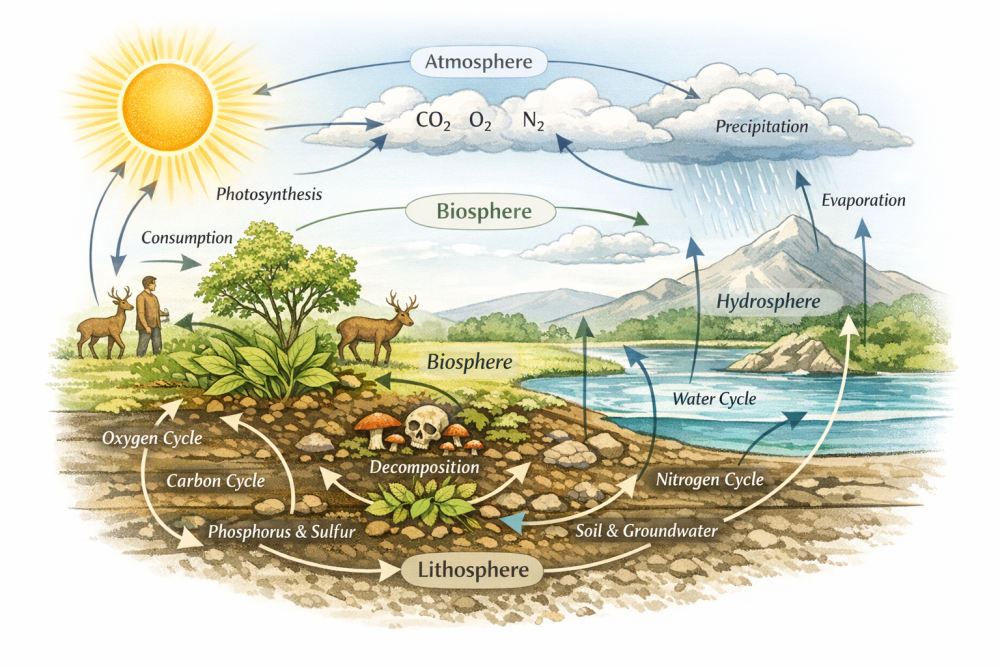
EH-12
Biogeochemical cycles describe the continuous movement and transformation of chemical elements between living organisms and the physical environment, emphasizing their vital role in sustaining life and fostering respect for Earth’s systems.
A defining principle of these cycles is efficiency: matter neither is created nor destroyed, but is continually transformed and reused. This continuous recycling sustains ecosystem productivity and maintains planetary equilibrium. Without such cyclical movement, essential nutrients would become depleted in some regions and accumulate excessively in others, ultimately disrupting life-support systems.
1.1 Earth as a Dynamic, Self-Regulating System
The Earth functions not as a static entity but as a dynamic, self-regulating network in which matter circulates among the biosphere, atmosphere, hydrosphere, and lithosphere. Coordinated biological, chemical, and physical processes link these spheres. For example, photosynthesis fixes atmospheric carbon dioxide into organic compounds, while respiration and decomposition return it to the atmosphere, maintaining balance.
This dynamic exchange is highly structured rather than random. Microbial processes regulate nitrogen transformations; geological processes, such as weathering and mineral release, redistribute gases globally; and atmospheric processes redistribute gases globally. The integration of these processes ensures continuity of life and long-term ecological stability.
1.2 Classification of Biogeochemical Cycles
Biogeochemical cycles are broadly categorized into two types based on their primary reservoirs.
Gaseous Cycles
These cycles have their primary reservoirs in the atmosphere or hydrosphere and are typically rapid and global in scale. The carbon, nitrogen, and oxygen cycles exemplify this category, driven largely by atmospheric exchanges and biological activity. The hydrological (water) cycle, although primarily physical, exhibits similar rapid dynamics through evaporation, condensation, and precipitation.
Sedimentary Cycles
The sedimentary cycles are largely confined to the Earth’s crust, soils, and sediments. Cycles such as phosphorus and sulfur are comparatively slower and more localized, relying on geological processes such as weathering, erosion, and tectonic uplift.
The distinction between these two types is critical: gaseous cycles are rapid and atmosphere-driven, whereas sedimentary cycles are slow and geology-driven.
1.3 Functional Pathways of Cycling
At the core of every biogeochemical cycle is a structured pathway for the transfer of matter. Solar energy is the primary driver, enabling photosynthesis in plants (primary producers), which convert inorganic substances into organic matter. These nutrients then move through food chains to consumers, including humans.
Respiration returns carbon dioxide to the atmosphere, while decomposers, which are primarily bacteria and fungi, break down organic matter, releasing nutrients into the soil and water. These nutrients are then reabsorbed by plants, completing the cycle.
This sequence of producers, consumers, decomposers, and back to producers demonstrates the continuity and efficiency of nutrient recycling. Importantly, while energy flows unidirectionally and dissipates as heat, matter is conserved and cyclic.
1.4 Ecological and Climatic Significance
Biogeochemical cycles are vital for maintaining Earth's climate and ecosystems, regulating atmospheric gases such as carbon dioxide and water vapor, which directly influence global temperature, precipitation, and biodiversity. Understanding these processes helps explain how Earth's systems support life and respond to environmental changes.
Biogeochemical cycles play a central role in regulating ecosystem stability and the global climate. The carbon cycle, for instance, governs atmospheric carbon dioxide levels, thereby influencing global temperature and climate patterns. Similarly, the water cycle determines precipitation distribution, directly affecting agriculture and biodiversity.
These cycles exemplify systemic integration, in which changes in one sphere affect others, inspiring awe at Earth’s complex and sensitive regulatory systems.
Unfortunately, biogeochemical cycles are increasingly disrupted by human activities, such as deforestation and fossil fuel use, underscoring the importance of understanding these processes for responsible environmental management and sustainability.
1.5 Biological Relevance of Major Cycles
Each biogeochemical cycle serves specific biological functions while remaining interconnected with others:
• Oxygen Cycle: Supports cellular respiration, enabling energy production in aerobic organisms.
• Water Cycle: Facilitates biochemical reactions, nutrient transport, and thermal regulation.
• Carbon Cycle: Forms the structural basis of organic molecules and regulates climate.
• Nitrogen Cycle: Essential for amino acids, proteins, and nucleic acids.
• Phosphorus Cycle: Critical for ATP, DNA, and cellular membranes.
• Sulfur Cycle: Influences protein structure and atmospheric chemistry.
These cycles are not isolated pathways but integrated systems that collectively sustain life. Their interdependence means that disruptions in one cycle can cascade into others, amplifying ecological consequences.
1.6 Conclusions
Biogeochemical cycles form the fundamental framework through which Earth sustains life and inform environmental policies. Their study supports sustainable resource management, climate mitigation strategies, and conservation efforts, emphasizing the importance of scientific understanding for effective stewardship amid rapid global change.
As subsequent chapters will explore, individual cycles, particularly the carbon cycle, provide deeper insights into natural regulation and anthropogenic impacts, bridging fundamental science and applied environmental solutions.