Can Peptides Help Humans Live Longer? Exploring the New Frontier of Longevity Science
Posted 3 months ago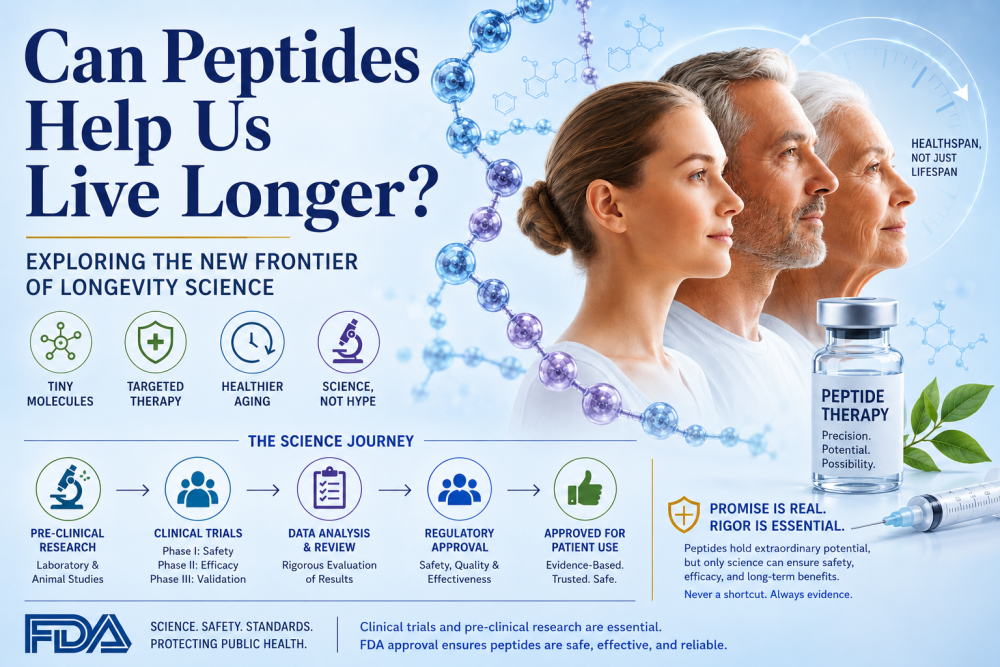
35/2026
Can Peptides Help Us Live Longer? Exploring the New Frontier of Longevity Science
In a recent article entitled “Is the peptide craze backed by science? The promise behind the hype Peptide injections are the hottest trend in wellness. Researchers say enthusiasm for these unregulated drugs has got ahead of the science.” published in the Nature journal, the author concludes:
“I’m very concerned about this whole trend,” he says. “The more people use them irresponsibly, the more issues I predict.”
The above statement is very alarming and requires appropriate measures to address the associated harms to human health. The biomedlobal explains the issue as follows.
To understand the growing fascination with peptides, it helps first to understand what they are. Peptides are short chains of amino acids, the same building blocks that make up proteins. Unlike larger proteins, peptides are relatively small, allowing them to act as precise biological messengers in the body. Every day, naturally occurring peptides in our bodies help regulate essential functions such as appetite, metabolism, hormone secretion, immune responses, tissue repair, and cellular communication. In many ways, peptides function as the body's internal communication network, directing cells to perform specific tasks at specific times.
Scientists have studied peptides for decades, but public interest surged after the success of peptide-based drugs for treating obesity and diabetes. Medications such as GLP-1 receptor agonists have shown that carefully designed peptides can yield remarkable health improvements, helping patients lose significant weight and improve blood sugar control. These achievements captured global attention and inspired researchers to investigate whether other peptides might offer similar benefits for a variety of medical conditions.
Today, peptides are being explored for an astonishing range of applications. Researchers are studying their potential to promote muscle growth, accelerate wound healing, reduce inflammation, improve recovery after injury, enhance cognitive performance, and support healthy aging. At the same time, commercial clinics and online vendors have begun marketing peptide therapies directly to consumers, often positioning them as cutting-edge solutions for wellness and longevity. This combination of scientific promise and commercial enthusiasm has fueled a rapidly expanding industry.
The scientific community, however, urges caution. While several peptide-based medications have undergone rigorous testing and received regulatory approval, many of the peptides currently marketed for anti-aging and wellness purposes have not been subjected to the same level of scrutiny. In many cases, evidence supporting their use comes primarily from laboratory experiments, animal studies, or small-scale clinical trials. Such early-stage findings are valuable because they help identify promising directions for research, but they do not necessarily prove that treatment is safe or effective for widespread human use.
One of the most intriguing areas of peptide research involves aging. Scientists around the world are searching for ways to extend not only lifespan but also health span, the number of years people remain healthy, active, and free from chronic disease. Certain peptides appear capable of influencing biological processes associated with aging, including inflammation, cellular repair, metabolism, and tissue regeneration. Some experimental studies suggest that these molecules may help maintain muscle mass, improve recovery, and support overall physiological function as people grow older.
These findings have generated considerable excitement because aging remains one of the greatest challenges facing modern societies. As populations live longer, age-related diseases such as cardiovascular disease, diabetes, dementia, and frailty place growing burdens on healthcare systems worldwide. Any intervention that slows biological aging could transform public health. Yet researchers emphasize that aging is an extraordinarily complex process involving countless interconnected pathways. Despite promising early results, no peptide has yet been conclusively shown to reverse or halt human aging.
The rapid commercialization of peptide therapies has also raised important concerns about safety and regulation. Some products are sold through channels that may not provide the same quality controls as those required for approved pharmaceuticals. Questions have been raised about product purity, manufacturing standards, dosing accuracy, and contamination risks. Because peptides interact with powerful biological systems, improper use could lead to unintended consequences. Scientists, therefore, stress that the assumption that "natural" automatically means "safe" is not always justified.
Medical history offers many examples of treatments that initially seemed revolutionary but ultimately failed rigorous scientific testing. For this reason, researchers advocate an evidence-based approach to peptide therapy. Enthusiasm should be balanced with careful investigation, and claims should be supported by high-quality clinical studies rather than marketing promises alone. The most important questions remain unanswered: Which peptides genuinely provide health benefits? Which individuals are most likely to benefit? What doses are optimal? And what are the long-term effects of repeated use?
Despite these uncertainties, the future of peptide research remains exceptionally bright. Advances in molecular biology, biotechnology, and drug development are enabling scientists to design increasingly sophisticated peptide-based therapies. Their ability to target specific biological pathways with remarkable precision makes them attractive candidates for treating a wide range of diseases. Many experts believe that peptide medicines will play an increasingly important role in healthcare over the coming decades, contributing to advances in metabolic health, regenerative medicine, and perhaps even aspects of healthy aging.
The current peptide boom, therefore, presents both an opportunity and a challenge. On the one hand, these tiny molecules offer extraordinary scientific potential and may lead to breakthroughs that improve millions of lives. On the other hand, the growing popularity of peptide therapies underscores the need for rigorous research, careful regulation, and informed public understanding.
Ultimately, peptides are powerful biological tools whose full potential is only beginning to be understood. As scientists continue to unravel their complexities, peptides may help shape the future of medicine in ways that are difficult to imagine today. Until then, the most reliable guide remains the same principle that has always driven scientific progress: follow the evidence wherever it leads.
Biomedglobal also echoes the Nature article's conclusion that before marketing any peptides, all necessary human-subject procedures, including clinical trials, must be completed, followed by necessary approvals from drug regulatory authorities such as the Food and Drug Administration (FDA).
Disclaimer
The contents provided on www.biomedglobal.org are intended for general informational and educational purposes only. This website's information, articles, and resources are based on data and findings from scientific publications, publicly available research, and reputable sources.
While every effort is made to ensure accuracy and reliability, Biomed Global does not guarantee, endorse, or assume responsibility for the completeness, timeliness, or validity of the information.
The material on this website should not be considered a substitute for professional advice, diagnosis, or treatment. Users are strongly encouraged to consult qualified healthcare professionals, researchers, or subject-matter experts before making decisions based on the information presented here.
Under no circumstances shall Biomed Global, its affiliates, contributors, or authors be held liable for any direct, indirect, incidental, or consequential damages arising from the use of, or reliance on, the content of this website.
By accessing and using www.biomedglobal.org, you fully acknowledge and agree to this disclaimer.