Fighting Dengue Through Education: BiomedGlobal Offers Life-Saving Healthcare Knowledge in Urdu
Posted 1 day ago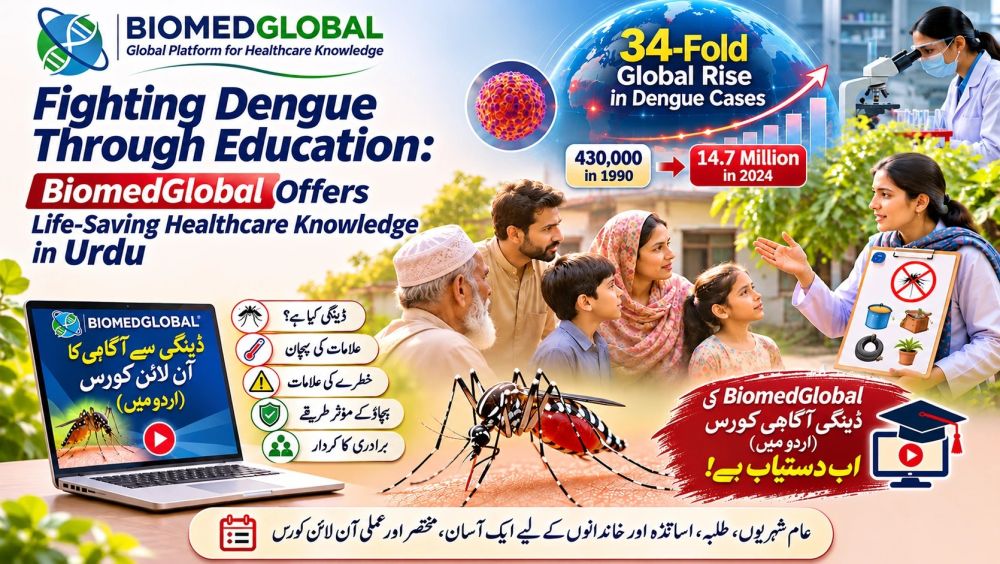
83/2026
How to stay safe from Dengue: A course in Urdu is available HERE
Dengue (a mosquito-borne viral disease that used to be largely seasonal in tropical regions) is spreading rapidly, putting millions at risk and straining health systems.
A recent Nature paper (25 November 2026) entitled 'Dengue has exploded globally in a truly stunning fashion' details the magnitude of this emerging health threat. A global analysis in the paper shows the number of recorded dengue cases has increased from around 430,000 in 1990 to 14.7 million in 2024 (a 34-fold increase in 34 years).
These numbers should be a wake-up call for governments, health professionals, educators and the general public. Dengue is no longer just a problem of the tropics. It is a significant international health issue which demands a coordinated response from the scientific, environmental and community sectors.
The message is simple: we can't afford to ignore dengue.
On the alarming rise in dengue cases globally, Prof. Emeritus Dr. Muhammad Mukhtar, Rector of the University of Southern Punjab (USP), Multan, Pakistan, and Editor-in-Chief of BiomedGlobal, has stressed the need to translate scientific knowledge into practical public awareness.
He makes it very clear that dengue prevention is not just a medical issue. It's a societal issue that requires informed citizens, responsible communities, a strong health system, and a government truly committed to it.
Prof Mukhtar made it clear that one of the major problems in the fight against dengue is the gap between what we know scientifically and what the general public actually knows. We know all sorts of things about the disease from a research perspective, but the public is still very much in the dark about how it spreads, the warning signs, and when to go to hospital.
He was keen to communicate health information in language people can understand.
"Scientific knowledge is of very little value to public health if it can't get to the people who actually need it. We need to take medical science out of the lab, out of the research journal, and out of the academic conference, and put it into people's homes, schools, and communities. Awareness can save lives, and education is one of our most powerful weapons against preventable disease."
In that connection, Prof Mukhtar has revealed that he is putting together a short, simple course on dengue in Urdu and Hindi for the Asian population at large.
The course will explain in plain language what dengue is, how the virus is transmitted, how to recognize the symptoms, what the red flags are (the things that you need to go to hospital for), what the family can do to prevent it, and how the community can go about eliminating mosquito breeding sites.
The course will also cover common myths about dengue, such as the idea that you can self-medicate, the mistaken belief that a low platelet count is always bad, and the dangerous notion that once your fever breaks, you're on your way to recovery.
He also said that once the Urdu/Hindi course is developed, an English version will be put together to reach a much wider international audience.
Through BiomedGlobal, this educational initiative aims to make reliable, evidence-based health information available to people outside the academic/professional world.
Prof. Mukhtar emphasized:
We aim to make the essential medical knowledge available and understandable to all. A mother looking after her child, a schoolteacher, a university student, a farmer, or indeed any member of the general public should be able to understand how dengue can be prevented and when it is appropriate to seek medical help. The point is to equip people with the knowledge to protect their families and communities.
A mosquito that has become a global threat
Dengue is caused by the dengue virus and is transmitted primarily by the bite of an infected female Aedes aegypti mosquito. This mosquito species lives very close to us. It breeds in small amounts of stagnant water, such as discarded tires, flowerpots, water containers, rooftop tanks, plastic bottles, and uncovered household storage.
Dengue is difficult to control because the mosquito doesn't need a pond, lake, or large pool to breed. A very small amount of standing water around a house can be a perfect breeding ground.
Several factors are contributing to the rapid expansion of dengue:
- Climate change: increasing temperatures and altered rainfall patterns are creating conditions that are conducive to mosquitoes surviving and spreading into new areas.
- Rapid urbanization: Growing cities, overcrowding, poor drainage, and inadequate waste management provide an abundance of breeding sites for mosquitoes.
- International travel: Infected travelers and the movement of mosquitoes via transport and trade networks can introduce dengue into new areas.
- Water storage: In areas where the water supply is unreliable, uncovered household water containers are ideal breeding sites.
- Inadequate public awareness: People don't know the mosquito breeding habits or the seriousness of dengue until someone in the family actually gets it.
The implications are particularly stark for countries in South Asia, SE Asia, and other tropical areas where high population densities, the climate, and the nature of urbanization can all contribute to the potential for transmission.
Dengue is not an ordinary fever: Recognize the danger.
One of the most dangerous myths about dengue is that it's just another seasonal fever.
Dengue can range from a mild illness to a severe and potentially fatal one. Some infected people have no symptoms at all; others have a high fever, severe headaches, pain behind the eyes, muscle and joint pain, nausea, vomiting, and a rash.
We must immediately seek medical attention if a dengue patient develops any of the following warning signs:
- Severe abdominal pain or tenderness.
- Persistent vomiting.
- Bleeding from the nose or gums.
- Blood in the vomit or blood in the stool.
- Rapid or difficult breathing.
- Extreme weakness, restlessness, or unusual drowsiness.
- Pale, cold, or clammy skin.
- Excessive thirst or signs of dehydration.
These can signal severe dengue and require immediate hospital assessment.
Another issue is that someone who has had one dengue infection can be infected again with a different dengue virus serotype. There are four major serotypes, and a second infection can increase the risk of severe disease.
Why early diagnosis and responsible treatment matter?
There is no specific antiviral to cure dengue. Management focuses on monitoring, keeping the patient hydrated, controlling fever, and managing complications. People who suspect they have dengue should see a qualified healthcare professional rather than self-medicate or rely on unproven home remedies.
For general information, we must remember that Paracetamol can be used for fever where appropriate. Aspirin and ibuprofen should be avoided as they increase the risk of bleeding.
Patients must understand that platelet count alone does not determine dengue severity or the need for transfusions. Clinical assessment, recognition of warning signs, hydration status, and laboratory monitoring are all key.
Public awareness of these facts can prevent dangerous treatment delays and save lives.
While the global situation is worrying, recent scientific advances offer cautious optimism. The Nature paper describes an ingenious approach: infecting mosquitoes with a naturally occurring bacterium called Wolbachia. This bacterium interferes with the mosquito's ability to transmit dengue. When you release Wolbachia-infected mosquitoes, they pass the bacterium on to their offspring, and so you end up with a population that is much less able to transmit dengue.
Very positive empirical evidence from Brazil.
Researchers released some 32 million Wolbachia-infected mosquitoes into the intervention areas between 2021 and 2022. They looked at nearly 6,000 children and found that those in the intervention areas were 68% less likely to get dengue than those in the comparison areas. This is a major milestone in the search for sustainable dengue control strategies.
Wolbachia is not a substitute for conventional mosquito control, public awareness, or medical care. It is an additional tool that must be implemented, monitored, and assessed carefully in different situations. The findings reinforce that science, coupled with community involvement and sound public health policy, can make a real difference.
For countries like Pakistan, India, Bangladesh, Sri Lanka, Nepal, and other dengue-endemic countries, that's of particular relevance.
Dengue prevention can't be left to the municipal authorities or government spraying. It has to be a shared responsibility of households, schools, hospitals, local government, and the community.
Several practical measures can make a significant difference:
At home
- Empty and clean water containers regularly.
- Keep your roof tanks and water storage vessels fully covered.
- Get rid of the discarded tires, bottles, cans, and all the other stuff that will collect rainwater.
- Clean the flowerpots, the drains, and any areas where water is likely to pool.
- Use mosquito repellent, window screens, and protective clothing.
In educational institutions
- Organize regular dengue-awareness campaigns.
- Inspect the campuses for potential mosquito breeding sites.
- Educate the students about the symptoms, the prevention, and the warning signs.
- Encourage students to become ambassadors of dengue prevention in their own communities.
At the community level
- Improve waste disposal and drainage.
- Carry out regular inspections of the public realm and of the private sector.
- Strengthen disease surveillance and early warning systems.
- Promote evidence-based mosquito-control programs.
- Encourage collaboration between the universities, the hospitals, the research institutes and the various government departments.
An effective dengue control program has to start with education. People must understand how dengue is transmitted and how their everyday activities can prevent transmission.
The world cannot afford to wait and keep seeing an increase in prevalence
The 34-fold increase in reported dengue cases is far more than just a number. It's millions of infections, it's families living in the constant state of uncertainty, it's health workers under immense pressure, and it's communities grappling with an entirely preventable disease.
The results from the Wolbachia work are very encouraging, showing that science can provide new solutions. Of course, no single intervention will eradicate dengue. A successful strategy will have to combine scientific innovation, environmental management, public health surveillance, medical preparedness, and community education.
Most importantly, every individual must realize that dengue prevention starts at home.
A discarded container holding rainwater, an uncovered water tank, or a neglected drain may seem like a minor issue; together, they can support mosquito populations and lead to outbreaks. We need to move from sporadic awareness campaigns to a culture of constant prevention.
Dengue is spreading faster than our public awareness. It's time to turn that around.
The battle against dengue has to start with knowledge, be built up through co-operation and be maintained through continued scientific innovation.
The question isn't whether dengue should be of concern. The question is whether we're prepared to act before the next outbreak takes any more lives.
An informed community is a protected community. Prevention of dengue starts with all of us.