New Hope for Rare Motor-Neuron Disease ALS: When Ribonucleic Acid (RNA) Becomes a Medicine
Posted 3 weeks ago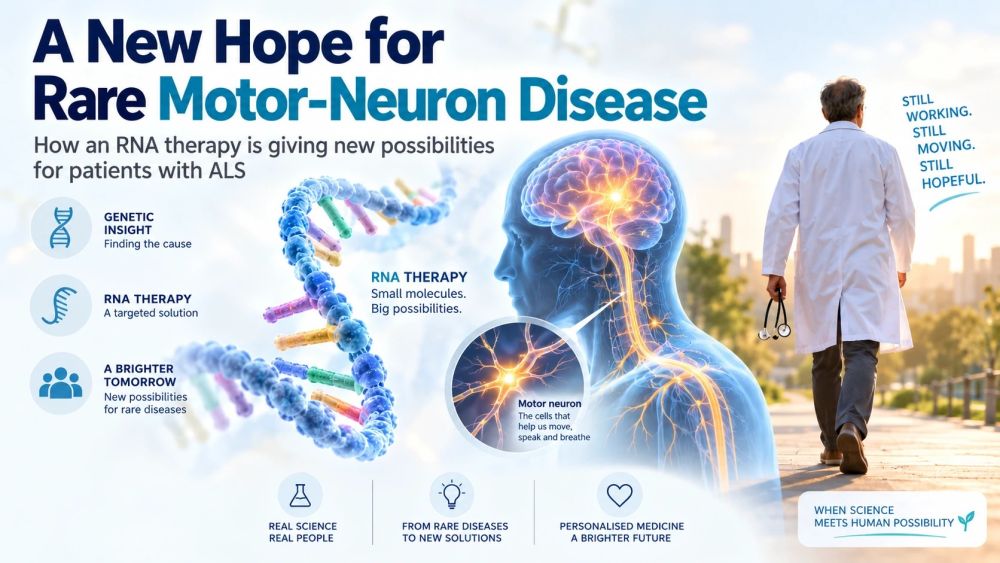
60/2026
Several neurodegenerative diseases have been extremely difficult for doctors and scientists to treat. The challenge becomes even greater when a disease is caused by a rare genetic change found in only one person or a very small number of people. In the past, developing medicine for such a rare condition could take many years, cost a great deal, and require highly advanced technology.
A case reported by Nature Journal in September 2026 suggests this may be changing. A man with a rare genetic form of amyotrophic lateral sclerosis (ALS), a serious motor-neuron disease, has improved after receiving an RNA-based treatment designed to target the mutation causing his illness. The result is based on a single patient, so it is far too early to call the treatment a cure. But it offers an extraordinary glimpse into a possible future in which medicines could be designed for an individual's genetic disease.
Understanding ALS: When the body's movement system begins to fail
To understand why this development matters, it helps to understand ALS.
Our brains control movement through specialized nerve cells called motor neurons. These cells carry instructions from the brain and spinal cord to muscles, enabling us to walk, speak, swallow, breathe, and perform countless everyday activities. In ALS, motor neurons gradually degenerate and die. As these cells disappear, muscles weaken. A person may initially have difficulty holding objects, walking, or speaking. Over time, the disease can cause widespread paralysis and eventually affect the muscles needed for breathing.
There is currently no cure for ALS, and the disease is often fatal, with average survival after diagnosis measured in only a few years.
A known genetic mutation does not always cause ALS. Only about 5–10% of people with ALS have an identified genetic cause. The patient described by Nature had an unusually rare mutation in the gene CHCHD10. This mutation occurs in fewer than 1% of people with ALS.
What does RNA have to do with it?
Genes are often described as the body's instruction manual. But genes do not directly produce proteins. Instead, they produce an intermediate molecule, ribonucleic acid (RNA), which carries the instructions for protein production.
This provides scientists with an intriguing opportunity.
Instead of altering the patient's DNA, the permanent genetic blueprint, researchers can sometimes target the RNA message produced by a faulty gene. The treatment used in this case is an antisense oligonucleotide therapy. In simple terms, these are very short pieces of genetic material designed to recognize a specific RNA message.
Imagine faulty genes as a factory producing too many harmful products. Traditional gene therapy might attempt to modify the factory itself. An antisense treatment, instead, tries to interfere with the instructions reaching the factory floor. In this case, the treatment was designed to reduce production of the abnormal protein linked to the patient's mutation.
From genetic discovery to personalized medicine
Perhaps the most remarkable aspect of the story is not merely that the treatment worked for one person. It is how quickly the team developed it.
According to the researchers, developing earlier antisense treatments for more common ALS mutations took at least a decade. The treatment designed for this patient's CHCHD10 mutation took about three years to develop, including laboratory and animal testing, before it was administered.
This represents an important shift in thinking.
For rare diseases, medicine has traditionally followed a "one treatment for many patients" model. New RNA technologies raise the possibility of a different model: one treatment tailored to a specific genetic mutation, potentially even for a single patient.
What happened to the patient?
In this case report, the patient suffering from ALS received six doses via spinal fluid. After a year, researchers reported several encouraging findings. His blood level of neurofilament light chain, a biological marker associated with nerve-cell damage, had fallen into the normal reference range. Measures of motor ability, breathing, and neurological function also improved, while breathing and cognitive measures remained stable. No serious adverse effects were reported.
Importantly, researchers remain cautious. ALS symptoms can sometimes fluctuate, and improvement in a single patient cannot establish that a treatment will work broadly. The researchers say the patient needs to be followed for several more years, and the treatment must be studied in additional people.
Could this change the future of rare diseases?
That is the bigger question.
If scientists can rapidly identify disease-causing mutations and develop precisely targeted RNA medicines, some previously untreatable rare neurological disorders could become candidates for personalized therapies.
The potential extends beyond ALS. Similar approaches are being explored for other genetic neurological and neurodegenerative diseases.
The most exciting possibility is that DNA sequencing, molecular biology, computational tools, and RNA technology could eventually work together to create medicines tailored to individual genetic conditions.
Yet this future will require careful science. Treatments must be tested for safety, effectiveness, durability, and affordability. A successful result in one patient is an important scientific signal, not proof that a general treatment has been found. However, the journey of a thousand miles begins with a single step.
Still, this case marks a remarkable moment in medical history.
For generations, patients with extremely rare genetic diseases have often been told that their condition was too uncommon for a medicine to be developed. RNA technology may be challenging that assumption.
The message from this pioneering case is therefore broader than one patient: the future of medicine may increasingly shift from treating diseases as broad categories to treating the precise molecular causes of disease in individual people.
It follows the paradigm of the Muslim Holy Book, the Quran, which says, “And whoever saves a life, it is as if he had saved all of humanity.”
Disclaimer
The contents provided on www.biomedglobal.org are intended for general informational and educational purposes only. This website's information, articles, and resources are based on data and findings from scientific publications, publicly available research, and reputable sources.
While every effort is made to ensure accuracy and reliability, Biomed Global does not guarantee, endorse, or assume responsibility for the completeness, timeliness, or validity of the information.
The material on this website should not be considered a substitute for professional advice, diagnosis, or treatment. Users are strongly encouraged to consult qualified healthcare professionals, researchers, or subject-matter experts before making decisions based on the information presented here.
Under no circumstances shall Biomed Global, its affiliates, contributors, or authors be held liable for any direct, indirect, incidental, or consequential damages arising from the use of, or reliance on, the content of this website.
By accessing and using www.biomedglobal.org, you fully acknowledge and agree to this disclaimer.