New Research Finding Will Lead to a Potential Cure through Destroying HIV Where It Hides in the Body
Posted 7 months ago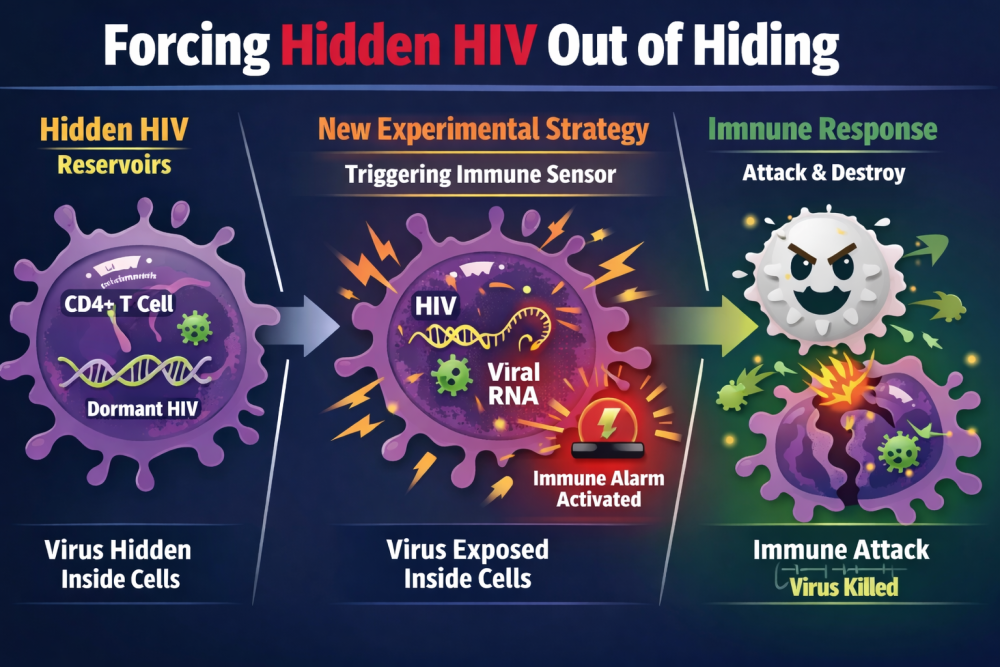
15/2026
For over forty years, the world has searched for a cure for HIV. Modern medications can suppress the virus so well that many people with HIV now live long, healthy lives. However, the virus still refuses to disappear completely. The reason lies in one of HIV’s most clever tricks: it hides. Deep inside the body’s immune cells, the virus can stay silent for years, invisible to both drugs and the immune system. Now, scientists believe they may have found a way to force the virus out of hiding and into the immune system’s crosshairs.
The Problem: HIV’s Invisible Reservoirs
HIV infects immune cells, especially CD4⁺ T cells, and inserts its genetic material directly into their DNA. Once integrated, the virus can enter a dormant state called “latency.” During this phase, the infected cell appears normal, produces no viral particles, and thus avoids detection by the immune system.
This silent group of infected cells is often called the HIV reservoir. It is the primary reason why a cure has remained out of reach. Even when antiretroviral therapy lowers viral levels in the blood to undetectable levels, these hidden reservoirs persist. If treatment is stopped, the virus can quickly reappear.
For years, researchers have attempted to eliminate these reservoirs using a strategy called 'shock and kill,' which aims to wake the virus and then let the immune system destroy the infected cells. Clarifying this process helps readers grasp its importance in HIV cure efforts.
Turning HIV’s Own Biology Against Itself
A new experimental approach offers a creative twist on that idea. Instead of merely awakening the virus, scientists aim to make infected cells recognize the virus themselves and activate an internal alarm to signal the immune system to eliminate the infected cells and the hidden virus inside.
Normally, human cells have sensors that detect viral genetic material. When these sensors are activated, the cell initiates an emergency response, sometimes even self-destructing to stop the infection from spreading. However, HIV has developed ways to turn off these alarms.
Researchers have now found a way to break this stealth mechanism. By altering the viral activity inside infected cells, scientists can make HIV produce signals that activate the cell’s innate immune sensor. Once activated, the sensor starts a chain reaction that alerts the immune system and may cause the infected cell to die, taking the virus with it.
Essentially, the strategy uses the virus’s own biology against itself. Instead of staying hidden inside the cell, HIV is forced to reveal itself.
A Different Kind of “Shock”
Traditional latency-reversal strategies aim to awaken dormant viruses with drugs that stimulate viral gene expression. The new approach takes a step further: it guarantees that when the virus wakes up, it cannot go unnoticed.
By activating the immune sensor, infected cells clearly signal that something is wrong. This may help immune cells identify and eliminate previously concealed HIV reservoir cells.
For scientists working toward an HIV cure, this marks a crucial shift in thinking. The aim is not just to activate the virus, but to ensure that activation leads to its elimination.
Why HIV Has Been So Hard to Cure
To understand the importance of this research, it helps to know about the unique biology of HIV. The virus belongs to the retrovirus family, meaning it permanently integrates its genetic material into human DNA. Once integrated, it becomes part of the cell’s genome, making it extremely difficult to remove or get recognized.
This ability to hide within the genome has frustrated scientists for decades. Even the most advanced antiviral drugs cannot target a virus that is not actively replicating. That is why people living with HIV often must take medication for life.
A few patients have been cured through rare medical procedures like stem-cell transplants from donors with natural resistance to HIV. Still, these cases are very uncommon and not feasible as widespread treatments.
The challenge has therefore been to find a therapy that can safely eradicate the viral reservoir within millions of infected cells throughout the body.
Early but Encouraging Science
The new immune-sensor strategy is still in its early experimental stages. Still, many believe it could lead to breakthroughs, with years of work ahead, including animal studies and human trials.
The new immune-sensor strategy has generated hope among researchers, as it tackles one of the biggest challenges in HIV cure research: how to reveal the virus’s hidden strongholds.
If scientists can reliably activate these immune alarms in infected cells, it could support other emerging methods, such as gene editing, immune-based therapies, or vaccines designed to boost the body’s ability to recognize HIV.
A Long Road Ahead with a Clear Destination
Worldwide, nearly 40 million people are living with HIV. Thanks to years of medical advances, the disease is no longer a death sentence, as it once was. Still, the lifelong need for treatment remains a significant challenge for individuals and healthcare systems alike.
The latest research offers a hopeful insight: defeating HIV may involve not just suppressing the virus but also making it reveal itself, bringing us closer to a cure.
By triggering the hidden virus to activate the body’s immune alarm system, scientists may finally be learning how to find and eliminate the last stubborn reservoirs of infection.
And in the ongoing fight against one of humanity’s toughest viruses, even a small crack in HIV’s armor is a significant step forward.
Disclaimer:
The contents provided on www.biomedglobal.org are intended for general informational and educational purposes only. This website's information, articles, and resources are based on data and findings from scientific publications, publicly available research, and reputable sources.
While every effort is made to ensure accuracy and reliability, Biomed Global does not guarantee, endorse, or assume responsibility for the completeness, timeliness, or validity of the information.