Plate Tectonics Science - The Ground Beneath You Is Moving
Posted 6 months ago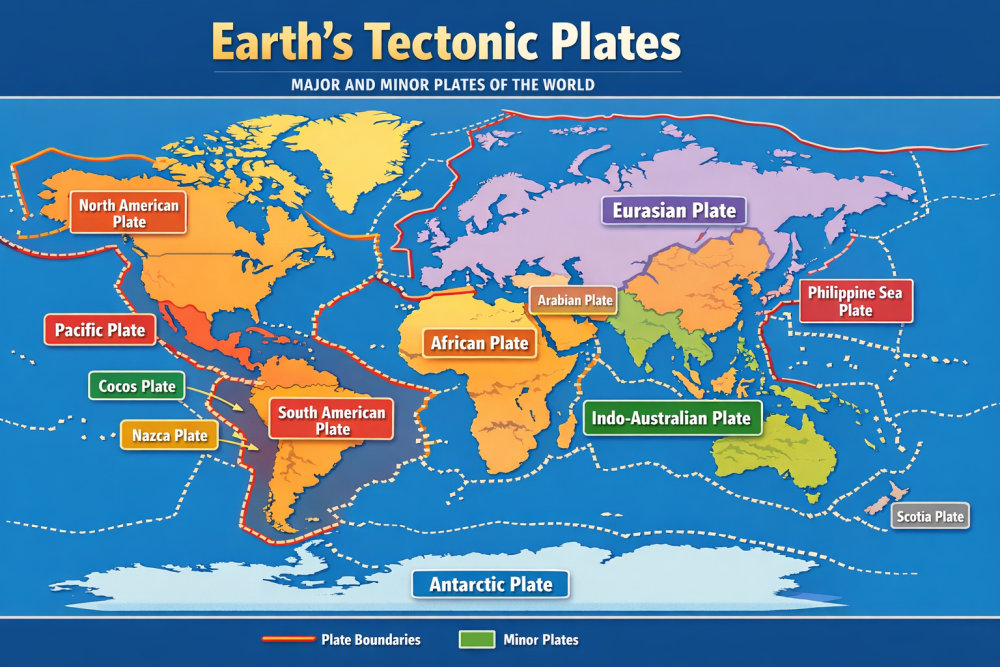
EH-7
When you look at mountains, oceans, and continents, it’s easy to think Earth is solid and unchanging. But beneath our feet lies a restless system in motion. The theory of plate tectonics explains how the Earth’s surface is constantly reshaped by slow yet powerful forces deep inside the planet. It is one of the most important scientific ideas in modern geology, helping us understand earthquakes, volcanoes, and even how continents form.
What is Plate Tectonics?
Plate tectonics is a scientific theory that explains how Earth’s major landforms form and change due to movements beneath the surface. Developed in the 1960s, it transformed Earth sciences by offering a unifying explanation for geological phenomena.
The Earth’s outer layer, known as the lithosphere, isn't a single solid shell. Instead, it is divided into large sections called tectonic plates. These plates consist of both continental and oceanic crust and rest on a softer, partially melted layer called the asthenosphere.
These plates are not stationary; they move slowly, usually at rates of 2 to 15 centimeters per year, about as fast as your fingernails grow. Although this movement may seem small, over millions of years, it has greatly reshaped the planet.
How Many Tectonic Plates Are There?
Scientists generally recognize seven major tectonic plates and many smaller ones. The total number ranges from 15 to over 20 plates worldwide, depending on the level of detail. The seven major plates include 1. Pacific Plate (beneath the Pacific Ocean); 2. North American Plate (covering North America, Greenland, and part of the Atlantic Ocean); 3. South American Plate (covering South America and part of the Atlantic Ocean); 4. Eurasian Plate (covering Europe and most of Asia); 5. African Plate (covering Africa and the surrounding ocean floor); 6. Indo-Australian Plate (including India, Australia, and nearby ocean regions); and 7. Antarctic Plate (covering Antarctica and the surrounding Southern Ocean).
Several smaller tectonic plates include:
- Nazca Plate – Off the west coast of South America (drives the Andes formation)
- Cocos Plate – Beneath Central America
- Caribbean Plate – Under the Caribbean region
- Arabian Plate – Includes the Arabian Peninsula
- Philippine Sea Plate – East of the Philippines
- Scotia Plate – Near Antarctica
What Drives Plate Movement?
The movement of tectonic plates is powered by heat from deep within the Earth. This heat creates convection currents in the mantle. Hot material rises, then cools and sinks again, much like boiling water in a pot.
This continuous motion acts like a conveyor belt, dragging the plates along. As a result, plates interact with each other in different ways:
- Divergent boundaries: Plates separate, forming new crust (e.g., mid-ocean ridges)
- Convergent boundaries: Plates collide, creating mountains or causing one plate to subduct beneath another.
- Transform boundaries: Plates slide past each other, frequently triggering earthquakes.
Real-World Examples of Plate Tectonics
The effects of plate tectonics can be seen across the globe:
- The collision of the Indian and Eurasian plates created the Himalaya Mountains.
- The East African Rift shows a continent slowly splitting apart
- The San Andreas Fault in California is a transform boundary where tectonic plates slide past each other.
- The Hawaiian Islands were formed by volcanic activity centered over a stationary “hot spot".
The Origin of the Theory: From Continental Drift to Modern Science
The story of plate tectonics starts with Alfred Wegener, a German scientist who introduced the idea of continental drift in 1912. He proposed that all continents were once connected in a supercontinent called Pangaea, which started to break apart about 200 million years ago.
Wegener noticed:
- Similar fossils on continents are now far apart
- Matching rock formations across oceans
- Coastlines, such as South America and Africa, fit together like puzzle pieces.
Despite strong evidence, his theory was initially dismissed because he couldn't explain how continents moved.
The Breakthrough: Seafloor Spreading
Decades later, discoveries filled in the missing piece. In the 1950s and 1960s, scientists mapped the ocean floor and discovered massive underwater mountain ranges.
An American geologist named Harry Hess introduced the concept of seafloor spreading.
- Molten rock rises from the mantle at mid-ocean ridges
- It cools to form a new crust
- The seafloor spreads outward like a conveyor belt
Older crust eventually sinks into the Earth at subduction zones, recycling the planet’s surface.
Magnetic patterns in ocean rocks and the relatively young age of oceanic crust strongly supported this theory.
Solving the Mystery of Isolated Volcanoes
One puzzling question remained: why do some volcanoes form far from plate boundaries?
John Tuzo Wilson, a Canadian geologist, explained this in 1963. He introduced the idea of hot spots, fixed areas deep in the mantle where heat rises and melts through the crust.
As tectonic plates move over hot spots, chains of volcanoes form. The Hawaiian Islands serve as a classic example, where each island indicates a past position of the moving plate.
Why Plate Tectonics Matters
Plate tectonics is not just an abstract theory; it directly affects our lives:
- Earthquakes occur along plate boundaries
- Volcanoes shape landscapes and influence climate
- Mountain building impacts weather patterns and ecosystems
- Natural resources like minerals and fossil fuels are linked to tectonic activity
Understanding plate tectonics helps scientists predict natural hazards and gain a better understanding of Earth’s history and what lies ahead.
Plate tectonics shows that Earth isn't a fixed planet but a lively, constantly changing system. From the movement of continents to the formation of mountains and volcanic eruptions, everything is connected through this powerful geological process.
What appears permanent beneath our feet is actually part of a slow, ongoing transformation, one that has been shaping our world for billions of years and will continue to do so.