AI detects heart disease within TWO seconds from ECGs
Posted 1 month ago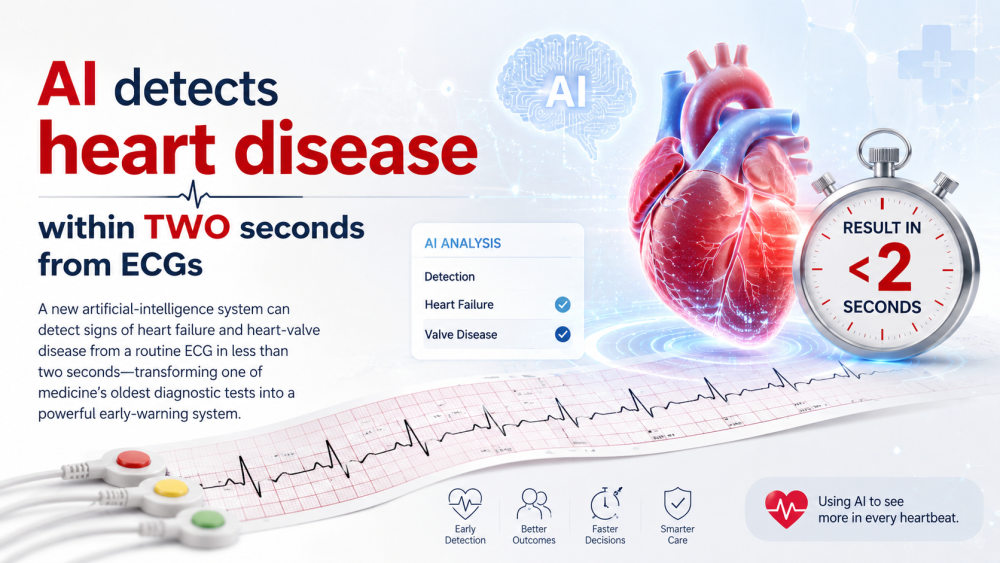
55/2026
Scientific findings presented at the European Society of Cardiology Congress in Munich, Germany, showed that a new artificial-intelligence system can detect signs of heart failure and heart-valve disease from a routine ECG in less than two seconds, potentially transforming one of medicine’s oldest diagnostic tests into a powerful early-warning system.
For more than a century, doctors have relied on the electrocardiogram (ECG) to monitor the heart's electrical rhythm. These signals reveal whether the heart is beating too fast, too slowly, or irregularly, and can provide important clues about a heart attack.
But the ECG has a major limitation. It records the heart’s electrical activity; it does not produce a picture of the heart itself. When doctors need to know whether the heart muscle is weakened or a valve is damaged, they generally turn to echocardiography, an ultrasound examination that shows the heart in motion.
That distinction may now be beginning to disappear.
Researchers at Imperial College London have developed an artificial-intelligence system that can analyze a routine ECG and detect subtle signals associated with heart failure and heart-valve disease, patterns that can be invisible to the human eye. In a reported U.S. trial involving about 67,000 people, the system identified up to 81 percent of patients with heart failure and up to 90 percent of those with heart-valve disease.
Technology was presented at the European Society of Cardiology congress in Munich, placing it among a growing wave of research using AI to uncover information hidden within familiar medical tests.
The idea is remarkably simple: perhaps the ECG has always contained more information than humans could extract.
An ECG is essentially a stream of numbers representing the heart’s electrical activity. A cardiologist recognizes waves and intervals. An AI system can examine thousands of subtle relationships among those signals simultaneously. By training on millions of ECGs linked to patients’ medical histories, the algorithm learns patterns associated with disease.
The researchers trained their models on enormous collections of ECG data, including more than 10 million recordings, according to reports on the latest work. Earlier research from the same Imperial group showed that AI could extract information from a standard ECG that goes well beyond conventional measurements of heart rate and rhythm.
What makes the latest development particularly interesting is not simply that the computer is fast. It is that the machine appears to recognize digital fingerprints of disease that are difficult, or even impossible, for a doctor to identify by looking at the tracing alone.
Consider heart failure. The disease can develop gradually, sometimes without dramatic symptoms in its early stages. Changes in the heart’s structure and function may alter its electrical behavior long before the condition becomes apparent. An AI trained on vast numbers of examples may detect those subtle changes even when the ECG appears relatively ordinary to a human observer.
The same principle applies to heart-valve disease. A damaged or narrowed valve alters how blood flows through the heart. That physical disturbance can affect the heart’s structure and electrical signals. The ECG does not directly show the damaged valve, but an algorithm may recognize the pattern it leaves behind.
ECGs are inexpensive, quick, and widely available. Around one billion ECGs are performed worldwide each year, making them among the most accessible medical tests. If an AI system can analyze those recordings almost instantly, it could flag high-risk patients and move them to the front of the queue for an echocardiogram.
That matters because access to specialist cardiac imaging can be limited. Patients may wait weeks or months for further evaluation. A rapid AI assessment could help doctors distinguish between patients who need urgent testing and those who can safely wait.
Technology could also reveal disease that nobody was looking for.
A person might receive an ECG because of chest discomfort, an abnormal pulse, or another medical concern. The AI could simultaneously analyze the recording for signs of heart failure or valve disease, even if the doctor had not suspected either condition. In this sense, the ECG could become an opportunistic screening test, quietly looking for hidden disease whenever it is performed.
Yet the word diagnosis needs to be used carefully.
The AI does not replace an echocardiogram, and it cannot independently confirm heart failure or a damaged valve. A positive AI result would instead indicate that further investigation is warranted. The system may also miss some people who have disease. That is why the next stage is not simply building a faster algorithm. It is determining whether using technology in real clinical settings improves patient outcomes.
Clinical investigation and human healthcare have accumulated enormous amounts of information from routine tests, including ECGs, blood samples, scans, and pathology slides. Much of that information is too complex for humans to interpret fully. AI offers a new possibility: rather than replacing established medical tests, it can teach us to see more in the tests we already have.
The ECG is more than a century old. Its electrodes, wires, and familiar waves may look almost primitive beside today's artificial intelligence. Perhaps the limitation was our ability to interpret what the heart was telling us. Now, in less than two seconds, a machine may be beginning to hear a little more.