FDA’s Emerging Technology Program (ETP): Preparing Medicines for the Future
Posted 1 month ago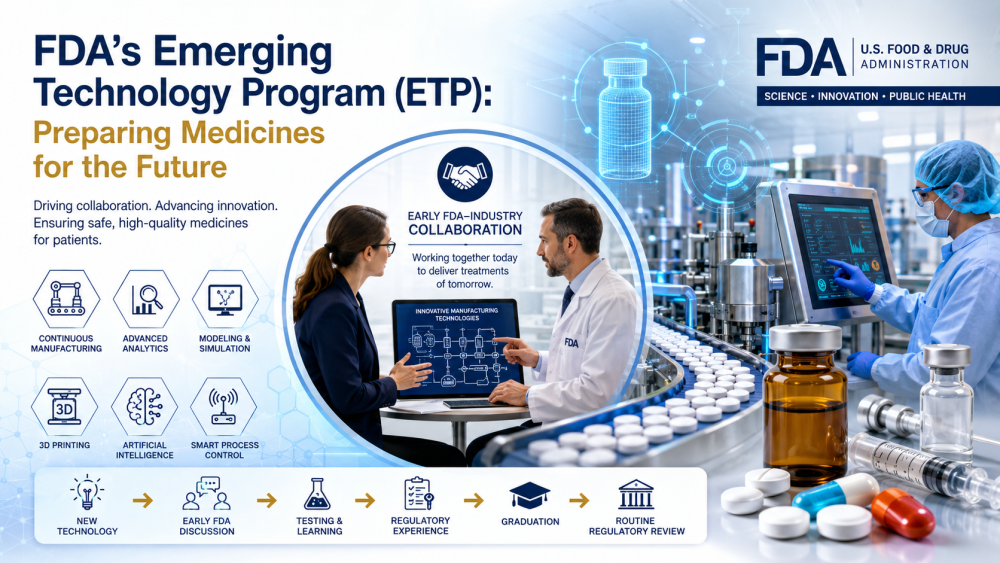
54/2026
The pharmaceutical industry is changing rapidly. The FDA’s Emerging Technology Program is helping ensure that new ways of manufacturing medicines can move from the laboratory to patients without compromising safety or quality.
For healthcare purposes, medicine begins with a prescription and ends with a tablet, injection, or other treatment. But behind every medicine lies a complex manufacturing process that is undergoing a technological revolution.
Pharmaceutical manufacturers are increasingly adopting continuous manufacturing, advanced analytical tools, computer modeling, 3D printing, sophisticated process controls, and other innovative technologies. These approaches could make medicines more consistent, efficient, and adaptable. But they also raise an important question: How should regulators evaluate a technology they have never encountered before?
The U.S. Food and Drug Administration (FDA) created its Emerging Technology Program (ETP) in 2014 to help answer that question. The Center for Drug Evaluation and Research (CDER) manages the program through its Office of Pharmaceutical Quality.
A Conversation Before Approval
The key idea behind ETP is early communication.
Instead of waiting until a company submits a drug application and then trying to understand an unfamiliar manufacturing technology, FDA experts can work with the company while the technology is still under development.
Companies propose technologies that are genuinely new and have the potential to improve the safety, identity, strength, quality, or purity of medicines. Technology may involve a new product or dosage form, a novel manufacturing process, or a new method for controlling and testing the manufacturing process.
If the FDA accepts the proposal, the company works with an Emerging Technology Team (ETT). This multidisciplinary team includes experts in pharmaceutical quality and inspections. Meetings, technical discussions, and, when appropriate, site visits enable the FDA and industry to identify potential problems before they become major regulatory obstacles.
Innovation in Pharmaceutical Manufacturing
The program has supported innovative approaches across areas such as continuous manufacturing, advanced analytical methods, modeling, and new dosage forms and drug-delivery systems. FDA has also considered technologies including 3D printing, process analytical technology, distributed manufacturing, and artificial intelligence in manufacturing.
One important example is continuous manufacturing.
Traditional pharmaceutical production often works in batches: one step is completed, the material is stopped, checked, and moved to the next step. Continuous manufacturing connects several operations so that materials move through the production system continuously.
Continuous Direct Compression - ETP in Action
One of the clearest examples of how the FDA’s Emerging Technology Program works is Continuous Direct Compression (CDC), an innovative method for manufacturing tablets.
In conventional tablet manufacturing, production steps are often performed separately, with material moving from one stage to another. In CDC, materials are continuously fed, blended, and compressed into tablets using integrated equipment, with no breaks between these steps. This provides greater flexibility to scale production in response to changes in demand.
The FDA worked with industry through ETP to understand the technology, identify technical and regulatory questions, and build sufficient experience to evaluate applications using CDC. This illustrates one of the program's central principles: the FDA engages with innovators early, rather than waiting until an unfamiliar technology appears in a formal application.
The experience eventually led to an important milestone. On October 21, 2021, Continuous Direct Compression became the first technology to graduate from ETP. Graduation meant that future applications qualifying under CDC could proceed through FDA's standard quality-assessment process rather than requiring continued involvement of the Emerging Technology Team.
In simple terms, the CDC example demonstrates the ETP model:
New technology → early FDA–industry collaboration → regulatory learning → sufficient experience → graduation → routine regulatory review.
The FDA continues to list other emerging technologies under the program, including continuous manufacturing, 3D printing, advanced process controls, next-generation sequencing, novel container-closure systems, and AI-related manufacturing approaches.
From Emerging to Everyday
This idea of “graduation” is one of ETP's most important features.
The program is not intended to create a permanent special pathway for every new technology. Instead, FDA works with industry until regulators have sufficient experience and confidence to evaluate the technology through the standard review process. Once that happens, the technology graduates. FDA transfers the accumulated knowledge to its regular reviewers, freeing the Emerging Technology Team to focus on the next generation of innovations.
In simple terms:
New technology → early FDA discussion → testing and learning → regulatory experience → graduation → routine regulatory review.
Why Does This Matter?
The importance of ETP extends beyond pharmaceutical factories. Improved manufacturing technologies can help companies produce medicines with greater consistency and control. They may also open the door to new types of medicines and manufacturing systems that were difficult or impossible to produce with conventional methods.
For patients, the ultimate goal is straightforward: safe, effective, high-quality medicines.
For scientists and pharmaceutical companies, ETP offers something equally valuable—an opportunity to discuss regulatory questions before investing years in a technology that may later face unexpected barriers. For the FDA, the program provides a way to keep regulatory science moving alongside technological progress.
Regulating Tomorrow’s Medicine
The pharmaceutical factory of the future may look very different from today's factory. Machines may continuously manufacture medicines, sensors may monitor processes in real time, computer models may help control production, and advanced technologies may enable medicines to be produced in increasingly personalized or distributed ways.
Regulation must evolve with that future.
The FDA's Emerging Technology Program marks an important shift in regulatory thinking: innovation and regulation need not move in opposite directions. By engaging in advance, sharing scientific knowledge, and learning together, regulators and industry can make room for new technology while preserving medicine's fundamental promise.
The real achievement of ETP may therefore be greater than any single technology it has supported. It is helping build a regulatory system capable of coping with emerging developments.