Single-Pill Combination Therapy: An Innovative Strategy for Hypertension Management
Posted 22 hours ago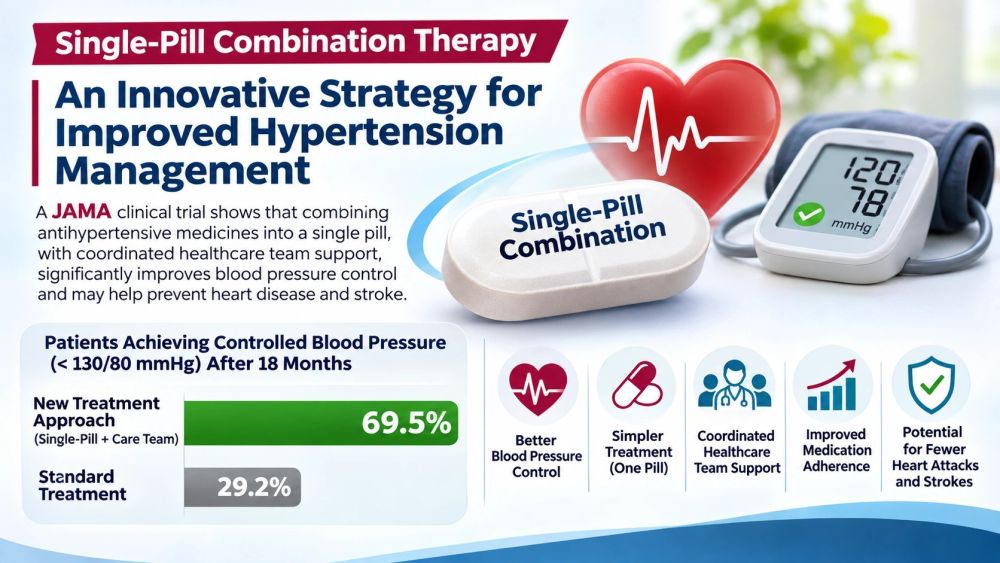
75/2026
A clinical trial published in JAMA demonstrates that combining antihypertensive medications into a single pill, supported by coordinated healthcare teams, significantly improves blood pressure control and may prevent numerous cases of heart disease and stroke.
Hypertension is among the most prevalent yet frequently inadequately controlled health conditions globally. Many individuals remain asymptomatic, unaware of the progressive damage to blood vessels, heart, kidneys, and brain. Uncontrolled hypertension significantly elevates the risk of heart attacks, strokes, kidney failure, and premature mortality.
Despite effective pharmacological therapies, blood pressure control remains a major public health challenge. Patients often must take multiple tablets daily, sometimes at different times. Complex treatment regimens, medication costs, forgetfulness, and limited access to healthcare services frequently hinder consistent adherence to prescribed therapies.
The study published in JAMA on November 8, 2026, provides evidence that a streamlined approach to treatment delivery may substantially improve hypertension management.
The central finding indicates that combining antihypertensive medications into a single tablet, alongside coordinated healthcare team support, produces significantly better outcomes than conventional treatment alone.
Inside the study: Evidence from 1,706 patients
The research, known as the Caribbean and South American Team-Based Strategy to Control Hypertension (CATCH) trial, was conducted in Colombia and Jamaica.
It involved:
- 1,706 adults with uncontrolled high blood pressure.
- 40 primary healthcare clinics, equally divided between the two countries.
- 20 clinics assigned to the new treatment strategy and 20 continuing standard care.
- An 18-month intervention, followed by an additional six months of follow-up.
Participants averaged about 61 years old, and nearly 70% were women. Importantly, about 98% were already taking blood pressure medication, yet their hypertension remained uncontrolled. This makes the findings particularly relevant: the study was not just testing whether medicines work in untreated patients. It examined how to improve treatment among people already receiving medication but still struggling to achieve healthy blood pressure levels.
What was different about the new approach?
The researchers introduced a comprehensive treatment model based on two key ideas.
1. Multiple medicines in one tablet
Instead of asking patients to take several separate tablets, doctors prescribed a combination of two or three blood pressure medicines in a single pill. These medicines work through different mechanisms to lower blood pressure. Combining them can provide better control while simplifying the daily treatment routine.
2. A coordinated healthcare team
The intervention went beyond prescribing a combination tablet. It united doctors, nurses, and community health workers to provide continuous support.
The program included:
- Training doctors and nurses in modern hypertension management.
- Regular health coaching to encourage medication adherence and healthier lifestyles.
- Providing patients with home blood pressure monitors.
- Encouraging patients to check their blood pressure at least twice a week.
- Regular follow-up appointments and medication adjustments when necessary.
- Monitoring treatment outcomes and providing feedback to healthcare professionals.
Thus, patients were integrated into an organized system of continuous care, education, and monitoring, rather than being left to manage prescriptions on their own.
Study Results: Significant Improvement Observed
The findings demonstrated substantial improvements in blood pressure control.
After 18 months, the average systolic blood pressure fell by:
- 19.1 mmHg in patients receiving the single-pill combination and team-based care.
- 9.0 mmHg in patients receiving standard treatment.
The difference between the groups was about 10 mmHg, a statistically significant improvement.
Even more impressive was the proportion of patients who achieved the study's blood pressure target of below 130/80 mmHg.
Patients achieving controlled blood pressure after 18 months.
This new approach resulted in more than twice the proportion of patients achieving the target blood pressure compared to standard treatment.
Approximately 70% of patients receiving the new intervention achieved controlled blood pressure, compared to fewer than 30% in the standard treatment group.
The benefits extended beyond the intervention period. At 24 months, six months after the formal intervention ended, 55.8% of patients in the new-treatment group maintained controlled blood pressure, compared with 34.2% in the standard-care group.
Researchers also reported increased patient satisfaction with medications and healthcare, as well as improved medication adherence.
Importantly, serious adverse events did not differ significantly between the two groups: 7.9% in the intervention group and 9.9% in the standard-care group.
Why does this research matter for developing countries?
This research extends beyond Colombia and Jamaica. It offers a valuable model for countries where healthcare resources are limited, and hypertension is often diagnosed but inadequately controlled.
The findings indicate that improved health outcomes can often be achieved without reliance on costly hospitals, advanced technology, or novel medications. Optimizing the organization of existing resources may yield substantial benefits.
For resource-constrained nations, this study suggests performing similar clinical trials to:
1. Simplify treatment: Encourage access to affordable, quality-assured single-pill combination medicines where clinically appropriate.
2. Strengthen primary healthcare: Equip basic health units and primary healthcare centers to diagnose, monitor, and manage hypertension.
3. Empower nurses and community health workers: Train them to educate patients, monitor treatment adherence, and support lifestyle changes.
4. Promote home monitoring: Encourage patients to measure and record their blood pressure regularly.
5. Improve medicine affordability: Ensure that essential combination medicines are consistently available through public healthcare facilities.
6. Establish continuity of care: Develop systems for regular follow-ups rather than treating hypertension as an occasional clinical problem.
Implementing these measures could transform hypertension management from a predominantly prescription-based service into a continuous, patient-centered healthcare program.
Important considerations
Although the findings are encouraging, the study has limitations. It was conducted in only two countries, so its results may not apply equally to every population or healthcare system.
Furthermore, the researchers evaluated improvements in blood pressure rather than directly showing reductions in heart attacks, strokes, or deaths. Longer-term studies are needed to establish the impact on these outcomes.
The success of this approach depends on the availability, affordability, and regulatory approval of combination medicines, and on healthcare systems' ability to maintain coordinated follow-up.
Patients should not independently switch medicines or combine tablets. Qualified healthcare professionals must determine treatment choices and dosages.
The bigger message: Better healthcare through smarter delivery
A key lesson from this JAMA study is that successful healthcare depends not only on discovering new medicines, but also on delivering effective existing treatments in ways that support consistent adherence, with engaged healthcare professionals.
Although hypertension is a chronic condition, its complications are frequently preventable. Simplified medication regimens, regular monitoring, patient education, and coordinated healthcare teams can collectively yield significant improvements.
The CATCH trial provides robust evidence that a single-pill regimen, supported by a dedicated healthcare team, achieves substantially better blood pressure control than conventional treatment alone.
For developing countries facing a growing burden of cardiovascular disease, this approach offers a promising, practical strategy to strengthen preventive care and protect population health.
Disclaimer
The contents provided on www.biomedglobal.org are intended for general informational and educational purposes only. This website's information, articles, and resources are based on data and findings from scientific publications, publicly available research, and reputable sources.
While every effort is made to ensure accuracy and reliability, Biomed Global does not guarantee, endorse, or assume responsibility for the completeness, timeliness, or validity of the information.
The material on this website should not be considered a substitute for professional advice, diagnosis, or treatment. Users are strongly encouraged to consult qualified healthcare professionals, researchers, or subject-matter experts before making decisions based on the information presented here.
Under no circumstances shall Biomed Global, its affiliates, contributors, or authors be held liable for any direct, indirect, incidental, or consequential damages arising from the use of, or reliance on, the content of this website.
By accessing and using www.biomedglobal.org, you fully acknowledge and agree to this disclaimer.