AI Is Discovering Nature’s Hidden Gene-Editing Machinery Among Viruses
Posted 3 weeks ago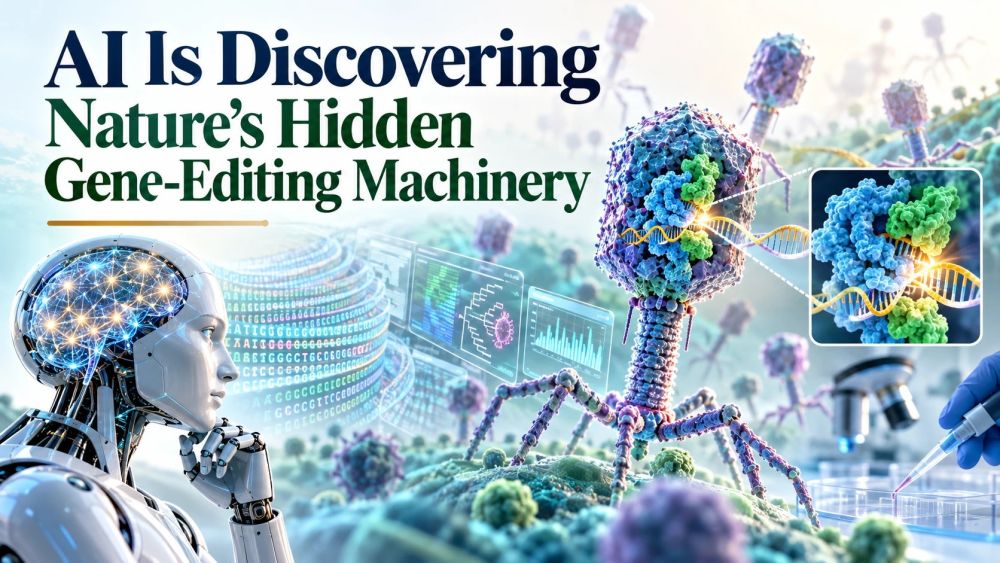
61/2026
Artificial intelligence is beginning to do something remarkable in biology: search through vast collections of DNA for biological systems that scientists may never have noticed. In a recent experiment, an AI-driven research team uncovered viral DNA sequences that appear to resemble some of the molecular machinery behind CRISPR (clustered regularly interspaced short palindromic repeats). The finding could open a new chapter in gene editing, but it also raises an important question: can AI move from discovering biological ideas to testing them in the laboratory?
CRISPR is a natural defense system used by bacteria and other microorganisms to recognize and fight invading viruses. Scientists adapted this system into a powerful technology for gene editing, the deliberate alteration of DNA inside a cell.
Now, researchers working with Anthropic's AI systems have asked a different question: What if nature contains many more CRISPR-like systems that humans have not yet discovered?
DNA: the biological instruction manual
To understand the discovery, let's first understand what DNA is.
DNA is the molecule that stores biological information. Think of it as a vast instruction manual written in a four-letter chemical alphabet: A, T, C, and G. A gene is a segment of DNA that encodes information for producing a specific protein or functional RNA molecule. Proteins, in turn, perform much of the work inside cells, from building structures to carrying out chemical reactions.
The difficulty for scientists is that DNA sequences can be extraordinarily long and complex. Finding an interesting biological mechanism hidden among billions or trillions of DNA letters can be like searching for a particular sentence in an enormous library where most of the books have never been read.
This is where AI can become useful.
What did the AI find?
The researchers were searching for DNA sequences associated with CRISPR-like systems in viruses.
A virus is a microscopic infectious agent whose genetic material can be DNA or RNA and contains instructions for reproducing inside a host cell.
CRISPR systems are particularly interesting because they allow organisms to recognize specific genetic sequences. In bacteria, for example, CRISPR-associated proteins can help identify and destroy genetic material from invading viruses.
The AI search identified viral DNA containing sequences that appear to encode components resembling known CRISPR-related machinery. In other words, the researchers found genetic clues suggesting that viruses themselves carry molecular systems with functions reminiscent of CRISPR.
That distinction is important.
This discovery does not mean that scientists have already found a new, fully functional CRISPR gene-editing technology. The Nature article describes the findings as the result of a large-scale computational search.
Why would viruses have such machinery?
This is one of the most intriguing questions.
Viruses are not merely passive packages of genetic material. They evolve extremely rapidly and interact with their hosts' molecular machinery and with other viruses.
Evolution is essentially nature's vast trial-and-error process. Genetic changes that confer an advantage can persist, while disadvantageous ones tend to disappear. Over billions of years, this process may have produced molecular mechanisms that scientists have never encountered. That means viruses could be an underexplored library of biological tools.
And this is where AI changes the scale of discovery.
AI as a biological detective
Traditional biological research often begins with a scientist asking a specific question:
What does this gene do?
The AI-driven approach can begin much more broadly:
Search vast amounts of genetic information and flag what looks unusual or potentially important.
This is a fundamentally different way of exploring biology.
AI systems are particularly adept at recognizing patterns in large datasets. A sequence that appears meaningless to a human researcher may contain subtle similarities to known biological systems.
Imagine giving an investigator access to billions of fingerprints and asking them to find those that resemble a particular pattern. A human could examine only a tiny fraction. A computer can compare enormous numbers of sequences. The Anthropic experiment used hundreds of AI agents to divide this work among many computational investigators.
But finding DNA is not the same as understanding it
This may be the story's most important lesson.
Prediction is not proof.
An AI can identify a DNA sequence that resembles a known biological system, but resemblance alone does not establish biological function. Scientists ultimately need to determine whether the suspected genes produce proteins, whether those proteins interact with DNA, and whether they perform the predicted function in a living system or in a laboratory experiment.
This requires wet-lab biology experiments involving biological materials, cells, proteins, and other laboratory systems. That is why the Nature article's central question is so provocative: AI may be exceptionally good at searching enormous biological databases, but how well can it perform the physical experiments needed to validate its discoveries?
From digital discovery to biological tool
If some of these newly identified systems work as predicted, scientists could investigate whether they have useful applications.
Gene-editing technologies are valuable because they allow researchers to modify DNA with increasing precision. Different molecular systems may eventually offer distinct advantages, for example, recognizing different DNA sequences or functioning under different cellular conditions.
A new model for scientific discovery
The viral CRISPR-like sequences are more than a curious finding. They illustrate a possible future for biology in which AI searches the world's genetic information for clues, while human scientists determine which clues correspond to real biological mechanisms.
The ultimate breakthrough may not be that AI has discovered another CRISPR.
It may be that AI is helping scientists discover biological possibilities that were previously hidden in plain sight.
And as the world's genetic databases continue to grow, the most interesting question may no longer be what biology we have discovered.
It may be:
How much biology is still waiting to be discovered?