The Nobel Prize in Physiology or Medicine: How Light Control the Brain?
Posted 2 weeks ago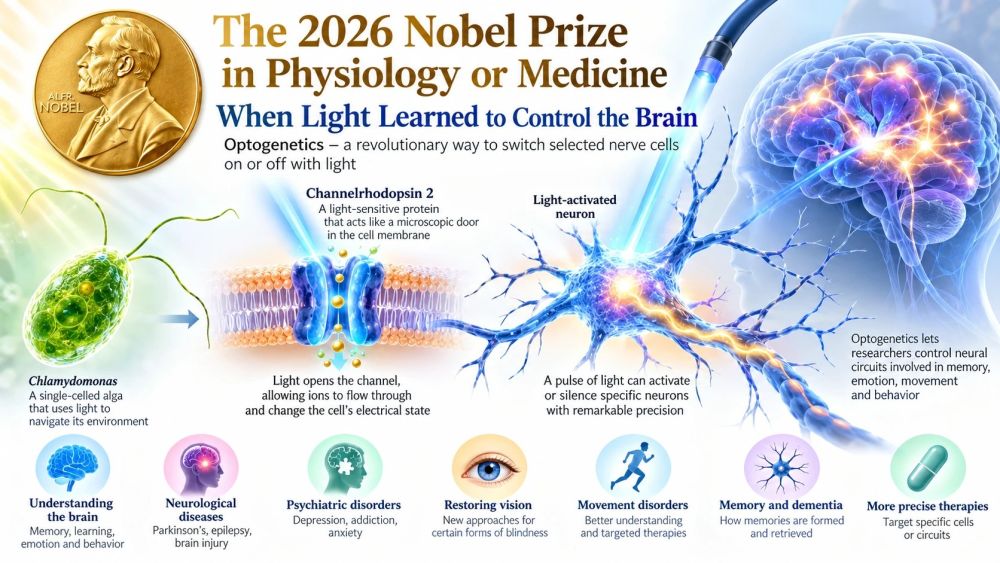
62/2026
The Nobel Prize in Physiology or Medicine 2026 recognizes a discovery that has transformed how scientists study the brain: using light to control nerve cells. Peter Hegemann, Georg Nagel, and Karl Deisseroth were honored for their work that led to optogenetics, a revolutionary technique that lets researchers switch selected neurons on or off with light pulses. What makes the story remarkable is that it began not in the human brain but with a tiny, single-celled alga, Chlamydomonas, that uses light to navigate its environment.
Hegemann and Nagel studied unusual proteins in microorganisms that respond directly to light. One of these proteins, channelrhodopsin 2, acts like a microscopic door in a cell membrane. When light strikes it, the door opens, allowing electrically charged particles called ions to flow through the membrane and change the cell's electrical state. The discovery suggested an extraordinary possibility: if scientists could introduce such a protein into nerve cells, perhaps light could control their electrical activity.
That insight became the foundation of optogenetics. Scientists can use genetic techniques to make specific neurons produce light-sensitive proteins. When a precisely timed pulse of light reaches those neurons, it can activate or silence them with remarkable precision. This differs fundamentally from stimulating the brain with an electrode, which can affect many neighboring cells at once. Optogenetics lets researchers target specific populations of neurons and ask much more precise questions about how the brain works.
The importance of this precision becomes clear when scientists study memory, fear, movement, motivation, or addiction. A researcher may observe that a group of neurons becomes active when an animal experiences fear. But observation alone cannot establish whether those neurons cause the behavior. With optogenetics, scientists can deliberately activate or silence the same cells and observe the resulting changes. The question therefore shifts from “Which neurons are active?” to the much more powerful “What happens when we control these neurons?”
The significance of the Nobel Prize in Physiology or Medicine, as outlined in the popular information, states:
“Using light, researchers are now able to switch individual neural circuits on or off in the brain. They can bring memories to life, create feelings, drive behaviors, and study the types of neurons involved in various psychiatric and neurological disorders. Optogenetics is fundamentally transforming our understanding of the brain. It has also provided important insights into how the nervous system interacts with various cells in other areas of the body, such as in the heart and gut.}
This ability has opened a new window into the brain's intricate circuits. Researchers have used optogenetics to investigate how neural networks contribute to memory, emotions, movement, sleep, reward, and disease. It has also spurred research into potential treatments for neurological disorders and, in some experimental approaches, the restoration of sensory functions such as vision. The technique does not mean scientists can shine light on a person's head and control thoughts; it requires making specific neurons light-sensitive through sophisticated biological methods.
The deeper significance of the Nobel-winning discovery is not merely that scientists found a way to “turn neurons on with light.” Rather, optogenetics has given neuroscience an unprecedented experimental tool for studying cause and effect in the brain. A protein that evolved in a microscopic organism to detect sunlight has become a molecular switch for exploring the neural circuits underlying memory, emotion, and behavior.
The journey is a powerful reminder of how unpredictable scientific discovery can be. Millions of years ago, nature developed light-sensitive proteins to help tiny organisms survive; scientists later recognized that the same molecular machinery could help unravel the mysteries of the human brain. In that sense, the 2026 Nobel Prize in Physiology or Medicine celebrates not only a technological breakthrough but also a new way of asking one of science's oldest questions: How does the activity of billions of living cells give rise to the thoughts, memories, emotions, and behaviors that make us human?
The discovery behind the 2026 Nobel Prize in Physiology or Medicine is and will benefit humanity in several important ways. The key point is that optogenetics gives scientists an unusually precise way to understand and potentially influence the neural circuits responsible for movement, memory, emotions, and behavior.
1. Better understanding of the brain - Scientists can identify which specific groups of neurons contribute to memory, learning, fear, motivation, movement, and decision-making. This helps explain how billions of nerve cells collectively produce human behavior.
2. New approaches to neurological diseases - Many disorders, including Parkinson’s disease, epilepsy, and some forms of brain injury, involve abnormal neural circuits. Optogenetics provides a powerful research tool for identifying what goes wrong and how to correct those circuits.
3. Potential treatments for psychiatric disorders - Depression, addiction, anxiety, and other psychiatric conditions involve complex neural networks. By precisely manipulating these circuits in experimental models, researchers can better understand disease mechanisms and identify new therapeutic targets.
4. Restoring vision and other sensory functions - One of the most promising applications is vision. Researchers are exploring ways to make surviving retinal or neural cells sensitive to light when photoreceptor cells are damaged. This could eventually contribute to treatments for certain forms of blindness.
5. Understanding and potentially treating movement disorders - By mapping the circuits controlling movement, scientists may develop more precise interventions for conditions such as Parkinson's disease and other neurological disorders.
5. Understanding memory and dementia - Optogenetics allows researchers to investigate how memories are formed, stored, and recalled at the level of neural circuits. This could improve our understanding of Alzheimer's disease and other disorders involving memory loss.
6. Development of more precise brain therapies - Perhaps the most important long-term benefit is conceptual. Instead of affecting large areas of the brain with drugs or electrical stimulation, future therapies may target particular cells or circuits much more precisely.
However, an important distinction remains between scientific potential and established medical treatment. Optogenetics is currently primarily a research technology, and many therapeutic applications remain experimental. Its greatest immediate contribution is helping scientists understand the brain well enough to design better treatments.
In simple terms, the Nobel-winning discovery gives neuroscience something like a precision switchboard. Rather than merely watching the brain operate, researchers can selectively activate or silence neural circuits and ask what those circuits actually do. That ability could ultimately lead to better treatments for neurological and psychiatric diseases and, perhaps, new ways of restoring functions that have been lost.
The profound promise is this: by learning how to control individual components of the brain's circuitry, humanity may eventually learn how to repair circuits that have gone wrong.
BioMedGlobal Congratulates the 2026 Nobel Laureates in Physiology or Medicine
The Rector of the University of Southern Punjab Multan, Pakistan, Prof. Emeritus Dr. Muhammad Mukhtar, and Editor-in-Chief of BiomedGlobal, extends its warmest congratulations to Peter Hegemann, Georg Nagel, and Karl Deisseroth on receiving the 2026 Nobel Prize in Physiology or Medicine for their pioneering discoveries that led to optogenetics, the revolutionary ability to control specific nerve cells with light. Their work represents a remarkable intersection of molecular biology, neuroscience, and technology. By transforming light-sensitive proteins into powerful tools for manipulating neural activity, the laureates have opened unprecedented opportunities to understand how the brain generates memory, emotion, movement, and behavior, while laying important foundations for future approaches to neurological and psychiatric disorders.
Congratulations to Professors Peter Hegemann, Georg Nagel, and Karl Deisseroth on this landmark achievement in neuroscience and biomedical science.