The Lithosphere: Structure, Dynamics, and Its Role in Environment and Human Health
Posted 7 months ago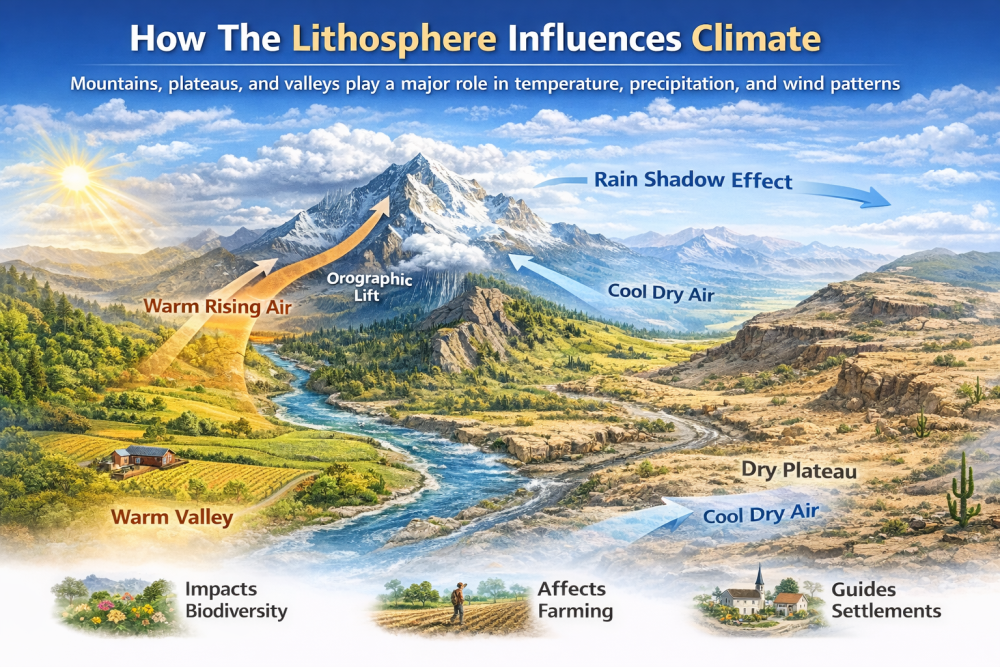
EH-6
The Lithosphere is Earth's outermost solid layer that supports all land-based life and influences climate, emphasizing its vital role in our planet’s health and stability.
Above the Lithosphere is the atmosphere, which supplies air and controls climate, making this boundary essential for surface-environment interactions and affecting ecosystems, climate systems, and human health.
Structure and Mechanical Properties of the Lithosphere
The Lithosphere consists of two main parts: the crust and the uppermost mantle. The crust’s thickness varies from about 5–10 kilometers under oceans (oceanic crust) to 30–70 kilometers under continents (continental crust). Beneath the crust is the rigid upper mantle, which, along with the crust, makes up the lithospheric plate.
The brittle nature and low ductility of lithospheric rocks are essential for tectonic plate movements, highlighting Earth's dynamic behavior and engaging curiosity about geological processes.
The concept of ductility, which describes a material’s ability to deform under stress, is essential in distinguishing these layers. The relatively low ductility of the Lithosphere allows it to fracture and form tectonic plates, while the higher ductility of the asthenosphere enables the movement of these plates. This mechanical difference is key to understanding Earth’s dynamic behavior.
Types of Lithosphere
The Lithosphere is mainly divided into oceanic and continental types, each with unique structural and compositional features.
The oceanic Lithosphere is linked to ocean basins and is generally thinner, denser, and younger than the continental Lithosphere. It mainly consists of basaltic rocks rich in iron and magnesium. The oceanic lithosphere is continuously created at mid-ocean ridges through volcanic activity and is eventually recycled into the mantle at subduction zones.
The differences between oceanic and continental Lithosphere are crucial for tectonic processes and influence the distribution of natural resources, emphasizing their environmental importance.
Tectonic Plates and Lithospheric Dynamics
One of the most important features of the Lithosphere is its division into large, rigid segments called tectonic plates. These plates include major ones such as the Pacific, Eurasian, African, North American, South American, Antarctic, and Indo-Australian plates, as well as several smaller plates, including the Nazca, Arabian, Caribbean, and Philippine plates.
The movement of these plates, driven by Earth’s internal heat, showcases Earth's dynamic nature and sparks curiosity about our ever-changing planet.
Tectonic interactions primarily occur at plate boundaries, which are classified into three types:
• Divergent boundaries, where plates move apart, leading to the formation of new crust at mid-ocean ridges.
• Convergent boundaries, where plates collide, resulting in subduction zones or mountain-building processes (orogeny)
• Transform boundaries, where plates slide past one another, often generating earthquakes.
These interactions cause some of the most dramatic geological events on Earth, such as earthquakes, volcanic eruptions, mountain building, and deep-sea trench formation. These processes constantly reshape the Earth’s surface, greatly affecting environmental conditions and human societies.
Interaction of the Lithosphere with Other Earth Systems
The Lithosphere does not operate in isolation; instead, it continually interacts with other Earth systems, such as the biosphere, hydrosphere, atmosphere, and cryosphere. These interactions are essential to maintaining Earth’s environmental balance.
The biosphere, which includes all living beings, relies on the Lithosphere for habitat, nutrients, and physical support. Soil, formed from weathered rocks, serves as the foundation for plant growth and supports land-based ecosystems.
The hydrosphere interacts with the Lithosphere through processes like erosion, sedimentation, and groundwater flow. Water shapes landscapes, transports minerals, and affects soil formation.
The atmosphere influences the Lithosphere through wind- and temperature-driven weathering, which affects landscape evolution and climate patterns, highlighting their environmental connection.
The cryosphere, which includes glaciers and ice sheets, interacts with the Lithosphere by eroding rock surfaces and moving sediments. Glacial movements can grind rocks into fine particles, aiding in soil formation.
The Pedosphere: A Critical Interface
A key product of lithospheric interactions is the pedosphere, the uppermost soil layer that supports life. The pedosphere forms through the combined effects of physical, chemical, and biological processes involving all Earth systems.
Weathering of rocks by water (hydrosphere), wind (atmosphere), and ice (cryosphere), combined with the decomposition of organic matter (biosphere), results in the formation of fertile soils. This process is vital for agriculture, ecosystem stability, and food security.
Lithosphere and Climate Regulation
The Lithosphere significantly influences climate patterns through its topographical features. Mountain ranges, plateaus, and valleys impact temperature distribution, precipitation, and wind circulation.
For example, mountainous areas typically encounter cooler temperatures and more precipitation, forming unique climatic zones. These differences affect biodiversity, farming methods, and where people settle.
Lithosphere and Human Health
The Lithosphere greatly affects human health, both positively and negatively. On the plus side, it provides vital resources such as minerals, fossil fuels, and fertile soils needed for farming and industry.
However, geological processes and human activities can pose serious health risks. Natural hazards such as earthquakes and volcanic eruptions can cause loss of life and damage to infrastructure. Furthermore, toxic elements such as arsenic, lead, and mercury in soils and groundwater can cause severe health issues.
Dust and particulate matter from degraded soils can cause respiratory diseases, while land degradation and soil erosion can threaten food security and nutrition.
Anthropogenic Impacts and Sustainability Challenges
Human activities have increasingly changed the Lithosphere, often causing harmful effects. Intensive mining, urban development, deforestation, and unsustainable farming practices have led to soil erosion, land subsidence, and biodiversity loss.
These impacts highlight the importance of sustainable management of lithospheric resources, including soil protection, responsible mining, and land-use planning, to foster a sense of responsibility and motivate action for environmental stability.
Conclusion
The Lithosphere is a vital and active part of the Earth system, serving as the physical foundation for ecosystems, climate regulation, and human societies. Its interactions with other Earth spheres create complex processes that support life and shape the planet’s surface.
However, the increasing pressures from human activity require a shift toward sustainable practices and responsible stewardship. A comprehensive understanding of the Lithosphere is therefore essential for addressing global challenges related to environmental sustainability, natural hazards, and public health.