The Promise and Peril of Gene Therapy: A Child's Death and the Ethics of Gene Editing
Posted 23 hours ago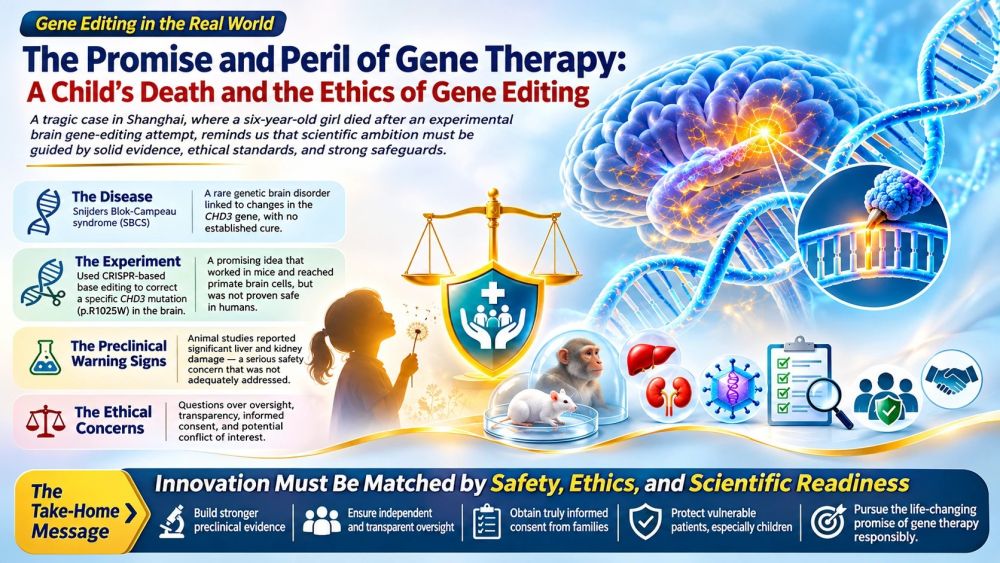
80/2026
The death of a six-year-old girl during an experimental gene-editing procedure in Shanghai reminds us that scientific ambition should not outpace solid evidence. The future of precision medicine depends on both our technical capabilities and our ethical and scientific readiness.
Modern molecular biology holds great promise. Scientists can now identify the genetic errors that cause inherited diseases and may be able to fix them at the source. Tools like CRISPR (Clustered Regularly Interspaced Short Palindromic Repeats) mediated base editing are changing medicine and giving hope to patients with conditions once thought untreatable.
A six-year-old girl with a rare genetic brain disorder died after an experimental gene-editing attempt. The investigation, reported in November 2026, led to the dismissal of two scientists and raised important questions about safety, oversight, consent, and research integrity.
This is more than a story about a failed experiment. It is about a vulnerable child, a family's search for help, scientists' duties, and the protections needed as biotechnology moves forward.
Understanding the disease: A rare genetic disorder with no established cure
The young patient was diagnosed with Snijders Blok-Campeau syndrome (SBCS), an extremely rare genetic neurodevelopmental condition. The syndrome is associated with disease-causing variations in the CHD3 gene, which provides instructions for producing chromodomain helicase DNA-binding protein 3. This protein plays an important role in regulating chromatin structure and gene expression, processes essential for normal brain development.
Put simply, our DNA holds the instructions for building and running the human body. These instructions must be well organized and tightly controlled. The CHD3 protein helps manage how genetic information is used during development.
When the CHD3 gene carries a harmful variant, this regulatory process may be disrupted, affecting brain development.
Children with Snijders Blok-Campeau syndrome associated with a variant in CHD3 can experience developmental delays, intellectual disability, speech and language difficulties, distinctive facial characteristics, and other neurological or physical manifestations. Symptom severity and combinations vary considerably from person to person.
For families, the impact goes far beyond just getting a genetic diagnosis. It can mean lifelong medical care, special education, speech and occupational therapy, rehabilitation, and heavy emotional and financial burdens. Importantly, no curative treatment currently exists for the syndrome. Management is primarily supportive and focused on the child's developmental and medical needs.
Because there is no cure, gene therapy (correcting the defective gene) through CRISPR and other methodologies seems especially appealing. But it also exposes families to the risks of unproven treatments.
The experimental intervention: Rewriting a genetic error
To see why this tragedy matters scientifically, we need to look at what the researchers tried to do. The clinical team targeted a specific mutation in the CHD3 gene, identified as p.R1025W. Their objective was to correct a single-letter error in the patient's DNA using adenine base editing, an advanced technology derived from CRISPR.
Imagine the human genome as a massive instruction manual with about three billion DNA base pairs. A genetic disease can come from just one wrong letter in that manual. Base editing tries to fix that single letter instead of rewriting the whole manual.
In this case, the researchers developed a specialized adenine base editor to convert the disease-associated mutation into the normal sequence, restoring production of functional CHD3 protein.
The idea behind the science was promising.
In February 2026, the research team published a paper in Nature titled In vivo base editing of Chd3 rescues behavioral abnormalities in mice. The study reported successful correction of the mutation in genetically engineered mice, restoration of CHD3 protein levels, and improvements in several behavioral abnormalities.
The researchers also investigated whether their editing machinery could reach brain cells in non-human primates using an adeno-associated virus (AAV9) delivery system.
This was a major scientific goal, moving from fixing genes in lab models to treating a human brain disorder. But it is important to remember that just because gene editing works in mice, it does not mean it is safe for a child's brain. Delivering treatment to primate brain tissue also does not guarantee it is safe for people.
The preclinical warning signs: Where the scientific process failed
The most troubling part of this case is not just that a new technology failed. Scientific experiments can fail, and unexpected side effects are part of biomedical research.
A bigger worry is that important safety warnings reportedly appeared before the child received the treatment.
Before any experimental intervention reaches a human patient, it must pass a rigorous process called preclinical evaluation. This usually includes lab investigations, disease modeling, animal studies, toxicology, biodistribution assessment, dose determination, and evaluation of potential adverse effects. The goal is simple: find dangers before giving an experimental treatment to a person.
In this case, the preclinical findings raised several serious concerns.
1. Liver and kidney damage in experimental animals
According to a Science report, a toxicology study involving four non-human primates found moderate-to-severe liver damage in all four animals. One animal also showed kidney damage. These results should have prompted a full investigation, additional safety tests, and a careful review of the planned human dose.
2. The challenge of delivering gene-editing machinery into the human brain
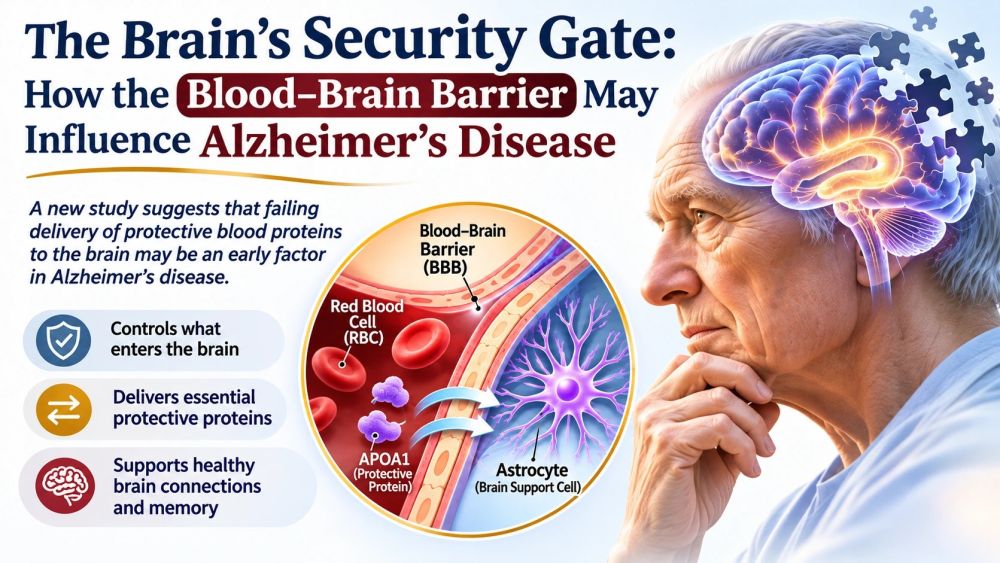
The brain is a very tough target for gene therapy. The blood-brain barrier keeps many harmful substances out of the central nervous system, but it also makes it very hard to get helpful treatments into brain tissue. The researchers therefore selected an adeno-associated virus serotype 9 (AAV9) viral vector and administered it through the spinal fluid to reach the central nervous system. AAV vectors are often used in gene therapy because they can deliver genetic material into cells. But high doses can cause strong immune and inflammatory reactions.
Another challenge was that the base editor was too large to fit into a single viral vector. The researchers split its genetic instructions between two AAV9 vectors, requiring both to reach the same target cells and reassemble successfully. This made the treatment more complicated and added new questions about how well it would work, the right dose, and how the body would react.
3. The unresolved problem of dosage and immune toxicity
A key issue in gene therapy is how many viral particles are needed for the treatment to work. A higher dose might deliver the genetic material to more cells, but it also increases the risk of harmful immune reactions. The girl received an exceptionally high number of viral particles.
After administration, she developed fever, severe kidney injury, and a decline in platelet levels. The hospital's emergency ethics review later attributed her death to thrombotic microangiopathy (TMA), a serious condition that damages small blood vessels and forms microscopic blood clots. TMA can compromise blood supply to vital organs, particularly the kidneys, and can become life-threatening.
The evidence raises big concerns about the immune response caused by the viral delivery system. But it is too soon to blame the fatal reaction only on the base-editing enzyme. The effects of the viral vector, immune response, dose, and other factors still need more study.
The ethics of experimentation: A family's hope is not a substitute for evidence
The hardest part of this story may be the family's experience. Parents of children with rare genetic disorders often spend years seeking answers. They see specialists, visit hospitals, try experimental treatments, and sometimes deplete their savings to make their child's life a little better. For these families, correcting a genetic mutation is not just a scientific breakthrough. It is hope for their child's future.
Reports say the family gave a large sum of money to help develop the personalized treatment. These situations can create serious conflicts of interest, especially when investigators have direct financial ties to families whose children might participate in experimental treatments. An important ethical distinction exists between accepting legitimate research funding through clear institutional channels and accepting personal payments or gifts from families in vulnerable situations.
The informed-consent process was also troubling. The investigation found that although the consent documents listed serious complications and adverse events, they did not clearly state that death was a possible outcome. When research involving humans is conducted for the first time, especially with children, consent must be extremely clear. Parents should understand the possible benefits, uncertainties, expected complications, and the possibility that the treatment could be fatal. Even if parents are willing to take risks, researchers and hospitals still have a duty to ensure those risks are scientifically supported and ethically acceptable. Children cannot judge complex experimental risks on their own. That’s why they need the highest level of protection.
Institutional oversight: What safeguards were missing
This tragedy also shows why independent scientific and ethical review matters.
The investigation, announced on November 13, 2026, found several failures at the institutional level:
- Leaders of the clinical research team were not informed promptly about concerning results from the nonhuman primate safety study.
- The hospital’s scientific review did not adequately evaluate the study’s design or safety.
- The ethics committee approved the study even though there was insufficient toxicology evidence and some requests for additional information remained unanswered.
- The consent process did not make it clear enough that death was a possible risk.
- Financial conflicts of interest were not fully disclosed.
- The scientific paper that followed did not properly report the negative findings from preclinical studies.
Two leading researchers were fired and banned from participating in science and technology projects or in award selection for five years. Other officials at the institution were also disciplined, demoted, or removed from their positions. The investigation did not find any fabricated data in the published Nature paper, though it did find academic irregularities and reporting problems.
What steps should have been taken before treating the child?
The main lesson is that preclinical research is not just a box to check. It forms the scientific foundation for research involving people. Several safeguards require special attention.
First, a thorough toxicological assessment is needed. Animal studies should assess the potential toxicity of the entire treatment, including the editing tools and their delivery method. Any signs of organ damage should prompt further investigation, not be ignored.
Second, choosing the right dose is crucial. Researchers need to set a scientifically sound starting dose, assess toxicity across doses, and determine whether the potential benefits outweigh the risks.
Third, scientists need to study where the viral vectors go in the body, which cells they reach, how long the editing tools remain active, and whether any unwanted genetic changes occur.
Fourth, there should be an independent review. Clinical approval should be based on a comprehensive, independent review of all preclinical evidence, including any negative results. The people who developed the treatment should not be the sole decision-makers on whether it’s ready for human use.
Fifth, informed consent must be clear. Families should receive an explanation they can understand of the treatment's experimental nature, the absence of proven benefits, the serious risks, and the possibility of death.
Sixth, long-term monitoring is needed. Gene-editing treatments can have effects that appear later, so follow-up must be thorough enough to detect any delayed problems.
These principles match international regulatory standards. For example, the US Food and Drug Administration’s May 2023 guidance, ICH S12, recommends nonclinical biodistribution studies for gene therapy products. These studies are key to understanding where a treatment goes in the body and how it acts.
Wider scientific implications: Innovation is not the same as clinical readiness
This incident should not stop scientists from advancing gene editing. Instead, it should encourage them to build even stronger scientific foundations for these important technologies. Precision medicine has already delivered real benefits to patients.
In 2025, doctors developed a personalized CRISPR-based treatment for an infant, Baby KJ, who had a severe metabolic disorder caused by a CPS1 gene mutation. The treatment demonstrated how quickly advances in genetic sequencing, molecular engineering, and precision medicine can converge to tackle a devastating condition.
However, we need to be careful with this comparison. Baby KJ’s treatment addressed a different disease, targeted a different organ, and used a different delivery method. It does not prove that administering high doses of gene-editing tools to the human brain is safe.
The Shanghai case matters because the brain is one of the most complex and difficult organs to treat. Brain development is shaped by complex interactions among genes, neurons, supporting cells, and the environment. Fixing a single genetic mutation does not always restore normal brain development, especially if changes have already occurred. There’s also a broader scientific question: How should researchers study the long-term effects of editing genes in a developing human brain? Answering these questions requires collaboration across many fields, including molecular genetics, neuroscience, virology, toxicology, clinical medicine, bioethics, and regulatory science.
A responsibility that goes worldwide
The lessons from this experiment are for every country investing in biotechnology. Our universities, research centers, and medical schools are increasingly focused on artificial intelligence, genomics, biotechnology, regenerative medicine, and precision healthcare. These fields are vital to our country’s scientific growth. But scientific progress is about more than advanced labs, costly equipment, or ambitious researchers. It also requires a culture of research integrity, accountability, and respect for human life.
We need to strengthen our biosafety committees, research ethics committees, preclinical research facilities, and independent scientific review systems. Universities should also invest in training researchers in Good Laboratory Practice, Good Clinical Practice, molecular diagnostics, genetic counseling, and responsible research conduct.
The final lesson: Science must always answer to humanity
The death of this little girl described in this article is a painful reminder that every genetic sequence, lab experiment, and scientific paper represents a real human life. Her parents hoped for a future in which their daughter could live a healthier, more independent life. The researchers were attempting something extremely ambitious: correcting a genetic error in the human brain. The scientific goal was admirable. But ambition alone cannot replace solid evidence, and good intentions cannot make up for lapses in research oversight. We need to distinguish among what is technically possible, what experiments have proven, and what is actually safe enough to offer a patient.
Gene editing could one day transform how we treat thousands of inherited disorders. It might offer hope to children with no other options. But this future depends on solid preclinical science, open clinical trials, independent oversight, and strict ethical standards. The true test of scientific achievement is not how quickly we can alter the human genome, but how responsibly we use that knowledge to protect and improve lives. The little girl in Shanghai deserved the very best modern science could offer. Most importantly, she deserved the protection that science should have provided.