When Living Cells and Genetic Material Become Medicines: The Regulatory Science of Ensuring Their Effectiveness.
Posted 22 hours ago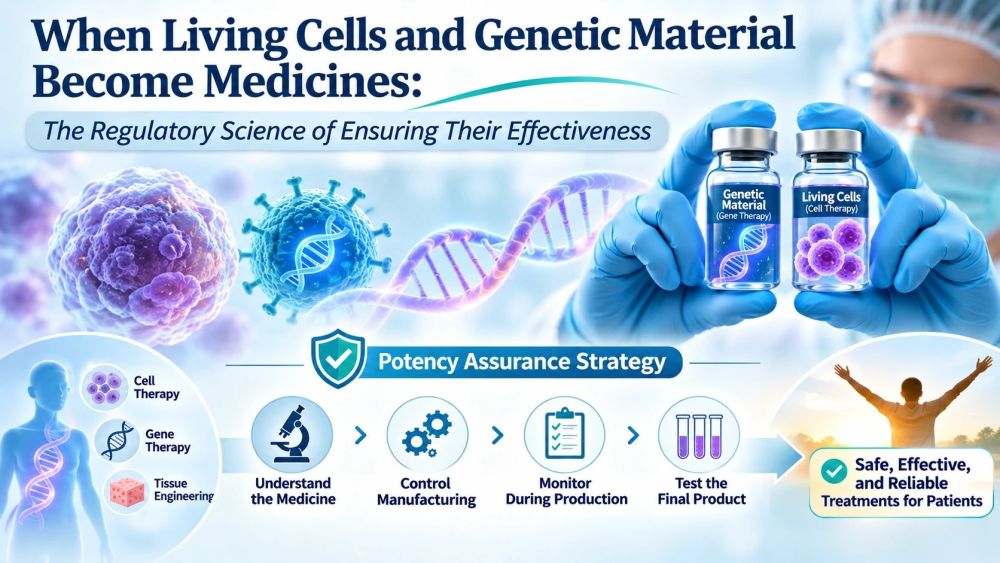
74/2026
The promise of cell and gene therapy is extraordinary. As we develop medicines with the capability to repair damaged tissues, reprogram cells, and correct genetic defects, one question becomes increasingly important: How do we ensure that every dose of these sophisticated treatments delivers the intended therapeutic benefit?
To see why that question matters, imagine a future in which a patient's own cells can be collected, modified in a laboratory, and returned to the body to fight cancer. Imagine a treatment that uses genetic technology to correct the underlying cause of an inherited disease rather than merely managing its symptoms. Or consider engineering living tissues to repair organs damaged by injury or disease.
These possibilities are no longer confined to science fiction. As cellular and gene therapies transform modern medicine, they are opening new possibilities for diseases that have historically been difficult or impossible to treat.
Yet this medical revolution brings a critical challenge. Unlike conventional medicines, which generally contain chemically defined ingredients, many advanced therapies are made from living cells, biological materials, or genetic components. As a result, numerous factors can affect their quality and effectiveness, including the characteristics of the original cells, manufacturing conditions, storage, transportation, and administration.
This raises a fundamental question: How can we be confident that every batch of a living medicine will work as intended?
The United States Food and Drug Administration (FDA) addresses this question in its November 2026 guidance, Potency Assurance for Cellular and Gene Therapy Products, which marks an important evolution in regulatory thinking on advanced biological medicines.
The above said document is straightforward but powerful: testing a medicine at the end of manufacturing is not enough. Its ability to produce the intended therapeutic effect must be protected throughout the entire manufacturing and product lifecycle.
What Does It Mean for Medicine to Be Potent?
In everyday language, potency may be understood as a medicine's strength. However, in advanced therapies, the concept is more specific. Potency refers to a biological product's ability to achieve its intended therapeutic effect.
For example, if cellular therapy is developed to destroy cancer cells, it is not sufficient to establish that the product contains a particular number of living cells. Those cells must also retain the biological capacity to perform their intended function.
Similarly, if a gene therapy is designed to deliver genetic material into cells and enable the production of a therapeutic protein, simply confirming the presence of the genetic material does not establish that the treatment will work. Scientists must also demonstrate the biological activity needed for the intended therapeutic effect.
This distinction is at the heart of the FDA's recommendations.
Why Is This Challenge Different from Conventional Medicines?
Consider the manufacturing of an ordinary pharmaceutical tablet. In that setting, manufacturers can generally measure its ingredients, concentration, dissolution, and other physical and chemical characteristics using established analytical techniques.
Living medicines are more complicated. Unlike ordinary pharmaceuticals, they require different considerations at every stage.
Cells are biological entities. They respond to their environment, change over time, and may behave differently depending on their source and previous exposure to disease or treatment.
Cellular therapy manufactured from one patient's cells may not behave exactly like a similar product manufactured from another patient's cells. Even relatively small variations in temperature, culture duration, growth conditions, or processing may influence the final product's biological activity.
Gene therapies face their own challenges. The genetic material must remain intact, the delivery system must function properly, and the intended genetic instructions must produce the desired biological response. Therefore, a product that appears satisfactory in a laboratory test may still have weaknesses that affect its therapeutic performance. Accordingly, the FDA recognizes these challenges and recommends a comprehensive, science-based approach to managing them.
Accordingly, the FDA recognizes these challenges and recommends a comprehensive, science-based approach to managing them.
The Most Important Message: Quality Must Be Built into the Medicine
Perhaps the most significant contribution of the new guidance is its emphasis on a concept that should influence the entire pharmaceutical and biotechnology industry: quality cannot simply be inspected into a product at the end. It must be built into every stage of development and manufacturing.
The FDA calls this Potency Assurance Strategy.
Think of manufacturing advanced biological medicine as preparing a highly sophisticated scientific recipe. The final product's quality depends not only on final inspection but also on the ingredients, the precision of preparation, the environmental conditions, and how the product is stored and delivered.
First, understand the medicine before manufacturing it.
Scientists must establish how the treatment is expected to work. They should identify the biological characteristics essential to its therapeutic effect. For example, if a cell therapy is intended to destroy cancer cells, researchers must identify the characteristics that enable those cells to perform this function.
Second, control the manufacturing process.
In practice, they must understand and monitor every important stage. The quality of starting materials, growth conditions, processing time, equipment, and storage conditions can influence the final product. Manufacturers should identify which process variables can affect therapeutic activity and establish appropriate controls.
Third, monitor the product during manufacturing.
Rather than waiting until production is complete, manufacturers should conduct appropriate tests at different stages.
For cellular products, these may include monitoring cell survival, growth rates, and biological characteristics. Such measurements can help identify problems before they affect the final product.
Fourth, test the finished product.
Before releasing a batch, appropriate laboratory tests must provide evidence that it meets established quality and potency requirements.
The important principle is that no single test can guarantee quality. Different safeguards must work together.
Laboratory Tests Must Demonstrate Biological Function
One of the most interesting aspects of the FDA guidance concerns potency assays: laboratory tests designed to measure whether a biological product has the characteristics necessary to achieve its intended therapeutic effect. These tests matter because advanced therapies may have multiple biological activities, and conventional chemical analysis cannot measure all of them.
The FDA emphasizes the importance of bioassays, which are tests that measure biological activity using living cells, tissues, or other biological systems.
For example, scientists may expose target cells to a therapeutic product and measure whether the expected biological response occurs.
However, these tests must themselves be reliable.
The guidance emphasizes that potency assays should demonstrate appropriate accuracy, precision, specificity, and robustness. In simple terms, they should produce results that are correct, consistent, relevant, and dependable under normal laboratory conditions.
Another important recommendation is to develop suitable reference materials. These provide a standard against which the performance of different product batches can be compared.
Without reliable reference materials, it becomes difficult to determine whether a new batch has maintained the same biological activity as previous batches.
The FDA also encourages laboratory-based alternatives to animal testing when they can provide adequate assurance of potency.
One Size Does Not Fit All
An important strength of guidance is its recognition that different advanced therapies require different approaches. For example, a gene therapy using a viral vector must demonstrate that the vector can deliver its genetic material and that the intended genetic instructions produce the required biological activity.
A patient-specific cellular therapy presents a different challenge. Because the product is manufactured using cells collected from an individual patient, the starting material's characteristics may vary considerably.
Tissue-engineered products present yet another challenge because their effectiveness may depend on physical structure, cellular characteristics, biochemical composition, and biological function.
The FDA therefore recommends designing potency assurance strategies around each product's scientific characteristics and intended use, rather than relying on a universal testing model.
This recognition reflects the complexity of precision medicine.
Safety and Effectiveness Must Be Protected Throughout the Product's Life
Another important message is that potency assurance does not end when a medicine leaves the manufacturing facility.
A product may lose some of its biological activity during storage, transportation, thawing, or preparation for administration. Even the delivery device may affect its performance. Consequently, manufacturers must investigate whether the product retains its intended biological activity under the conditions in which it will actually be used.
The guidance also addresses manufacturing changes. If a company changes its manufacturing process, it must evaluate whether that change could affect the product's potency, safety, or effectiveness.
For licensed biological products, the FDA requires an appropriate assessment of manufacturing changes before distributing the modified product.
This is particularly important because patients receiving advanced therapy should not become unknowingly exposed to a product whose biological characteristics have changed.
An Evolving Standard, not a One-Time Exercise
The FDA also recognizes that scientific knowledge develops progressively.
A new cellular or gene therapy may enter early clinical investigation before every aspect of its biological activity is fully understood. Therefore, potency assurance should develop alongside the product.
During early research, manufacturers should establish preliminary quality characteristics and identify potential risks. As clinical experience and manufacturing data accumulate, the testing strategy should become more comprehensive.
By the later stages of clinical development, manufacturers should have a well-established potency assurance system, including appropriately qualified and validated assays.
What Does This Mean for the Future of Medicine?
The implications extend well beyond regulatory compliance.
According to Prof. Emeritus Dr. Muhammad Mukhtar, Rector of the University of Southern Punjab, Multan, Pakistan whose earlier work with hundreds of scientists set the stage of gene and cell therapy believes that: Cell and gene therapies represent a fundamental change in how medicine is conceived and delivered. We are moving from treatments that primarily introduce chemical substances into the body towards therapies that use biological systems themselves as therapeutic instruments.
This transition demands a corresponding evolution in pharmaceutical manufacturing, analytical science, biotechnology education and regulatory expertise. Universities and research organizations performing preclinical/clinical research must prepare a new generation of scientists who understand not only molecular biology, genetics and cellular engineering but also bioprocessing, analytical validation, quality assurance and regulatory science.
Biotechnology companies must invest in advanced manufacturing infrastructure and reliable analytical platforms.
Healthcare regulators must continue developing scientific capacity to evaluate increasingly complex biological products.
Equally important, the public must understand that scientific innovation alone does not guarantee successful treatment. Credible evidence of quality, safety, and effectiveness must support every promising therapy.
It is also important to recognize that the November 2026 FDA document is industry guidance, not a new, universally binding regulatory law. It supersedes the FDA's January 2011 guidance on potency tests for cellular and gene therapy products and provides a more comprehensive, quality risk management framework. Existing statutory and regulatory requirements remain applicable.
The Final Test of Medical Innovation
The greatest achievement of modern medicine will not simply be discovering new ways to manipulate genes, engineer cells or regenerating tissues. It will ensure that these discoveries translate into dependable treatments for patients.
A revolutionary therapy that works in one laboratory but fails to maintain its biological activity in another cannot fulfill its promise.
The real measure of progress is consistency: ensuring that every patient receives a product with the intended biological capability, supported by sound science and reliable quality controls.
The FDA's new guidance reinforces a vital principle for the future of healthcare: we must not only learn how to create living medicines; we must also learn how to ensure that they remain alive, active and therapeutically effective when patients need them most.
That is how scientific breakthroughs become trustworthy medical treatments. And that is how the promise of cellular and gene therapy can become a lasting reality for humanity.
Disclaimer
The contents provided on www.biomedglobal.org are intended for general informational and educational purposes only. This website's information, articles, and resources are based on data and findings from scientific publications, publicly available research, and reputable sources.
While every effort is made to ensure accuracy and reliability, Biomed Global does not guarantee, endorse, or assume responsibility for the completeness, timeliness, or validity of the information.
The material on this website should not be considered a substitute for professional advice, diagnosis, or treatment. Users are strongly encouraged to consult qualified healthcare professionals, researchers, or subject-matter experts before making decisions based on the information presented here.
Under no circumstances shall Biomed Global, its affiliates, contributors, or authors be held liable for any direct, indirect, incidental, or consequential damages arising from the use of, or reliance on, the content of this website.
By accessing and using www.biomedglobal.org, you fully acknowledge and agree to this disclaimer.